A project for the country, or a project for power?
In this article
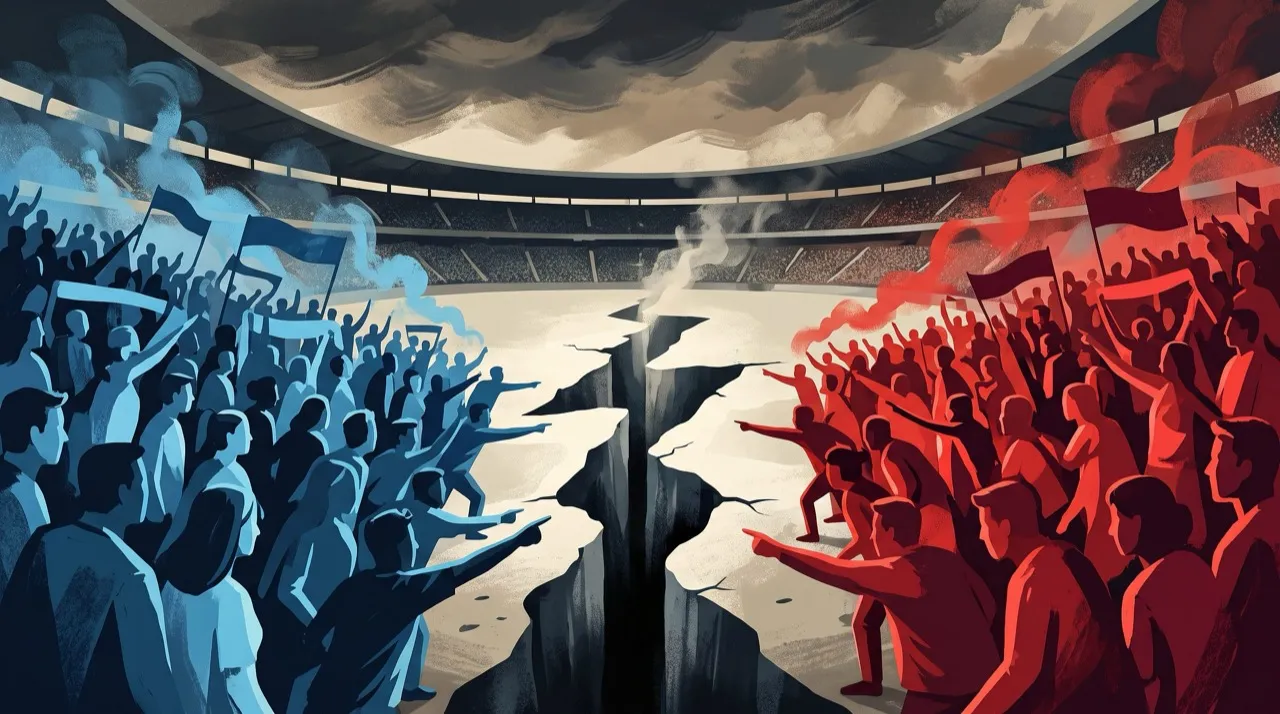
“Hey, whose side are you on? Nobody can please both sides,” Humberto Gessinger
It all comes down to a fight between rival fans
And us stuck in the middle, in the middle of the flags
The game doesn’t matter, nobody’s watching
And us stuck in the middle, in the middle of the blindness
It all boils down to a battlefield
And us stuck in the middle
It all comes down to a dispute between parties
Mud in the press, blood on the flags
The truth slips by, as if it didn’t exist
And us stuck in the middle, as if we didn’t exist
It all boils down to a cross and a sword
Vícios de Linguagem (“Figures of Speech”), Humberto Gessinger.
Engenheiros do Hawaii, Simples de Coração (1995).
Sadly, I come back to this song by Engenheiros do Hawaii every election. Gessinger wrote it in a year marked by violence between rival fans in soccer stadiums, and he used that clash to talk about something bigger: the political dispute and the speeches crafted to persuade, in which everyone gets pushed to one side and the truth ends up on the sidelines.
The vote has become a team jersey, and conversation, even among friends and family, looks more and more like an argument in the stands. Each side knows very well who it doesn’t want in power. Few people can say where they want the country to go.
My father wrote a reflection about this in the family WhatsApp group. A Catholic with a long life in the Church, he sees the divergence between right and left as legitimate, because democracy exists precisely so that different people can disagree without becoming enemies. What worries him is politics that stops competing over ideas and starts seeking domination: the fusion of political, economic, judicial and religious power, faith used as a tool for electoral mobilization, and the ruler treated as someone chosen by God to save the nation.
That’s why, before voting, my father says he weighs character, proposals, commitment to the Constitution, respect for institutions and the ability to govern for everyone, including those who think differently. And he ends with a question: “Is the candidate defending a project for the country, or a project for power?”
What an election really chooses
An article published in Sigma Society helps explain why that question is so hard to answer. The author starts from a line attributed to Nelson Rodrigues, “idiots will lead the world, not because of their ability, but because of their numbers,” and acknowledges that it oversimplifies the issue, but touches on something real.
Throughout history, power has rarely gone to those who deserved it most or knew the most. The article shows that it goes to those who know how to mobilize the majority, through shallow rhetoric, fake news and mechanisms of social influence, and that the most efficient form of domination may be convincing people they’re defending their own interests while they serve the interests of those leading them.
One of those mechanisms is the herd effect, in which people follow the group without examining the evidence, driven by the desire to belong. In polarized contexts, it gains strength because political support becomes a matter of identity. Agreeing with a candidate’s ideas is no longer enough; you have to defend the group, reject opponents and tolerate the failings of allies. It’s Gessinger’s crowd of fans outside the stadium. Germany, with all its scientific and intellectual tradition, was not immune to the manipulation that led to barbarism, and it’s fair to ask why a country with Brazil’s educational shortcomings would be better protected.
The allegory of the ship, in Book VI of Plato’s Republic, helps make the problem visible. The sailors fight over the helm without mastering the art of navigation, while the true navigator, who understands the winds, is treated as useless. Convincing the crew to hand over command is a different skill from knowing how to steer the ship. An election directly measures the ability to win votes and only indirectly the ability to govern, which leaves room for people with rhetorical talent to look competent without ever having proven it. And, as in Orwell’s Animal Farm, those who come to power preaching justice often end up reproducing the privileges they fought against, under any regime.
The text goes further and claims that no real democracy exists anywhere in the world, only oligarchies and plutocracies under that name. I stop at a less radical point, but I share the discomfort and the practical remedies it proposes: ask what the candidate has already done, whether they kept their promises and whether their proposals hold together, use the same yardstick for allies and opponents, and choose the least bad option when none is satisfying.
I agree with my father and with much of this diagnosis. But I think a piece is missing from this conversation.
A ship with no course
Even the best navigator needs to know where the ship is going. And Brazil, with every election, can change both the captain and the destination.
Each president who takes office sets priorities and actions according to their own project, which almost always includes keeping their group’s power and influence. What was a priority in one term loses steam in the next, programs change names, public works are left half-finished and the country starts over far too often. In this scenario, voters have no common reference for comparing what each candidate proposes, and the choice goes back to the stands.
Brazil has made long-term plans before. In 2020, the federal government established by decree the Federal Development Strategy 2020-2031, with five pillars, key indices and targets for 2031. In 2025, already under a different government, the Ministry of Planning began drafting the Brazil 2050 Strategy, with regional seminars, a public consultation through the Brasil Participativo portal and the goal of doubling per capita income in 25 years.
That’s two long-term plans in five years, each born inside a government and bearing that government’s signature. Even the Multi-Year Plan, required by the Brazilian Constitution, covers four years and reaches only one year into the next term. We have government plans that go by the name of national plans.
I think the problem goes beyond discontinuity. I’d venture that few Brazilians know these documents exist, and even fewer could say who is held accountable for the targets they set. When a plan is launched with ceremony, consultation and ambitious numbers, but nobody tracks its indicators or answers for them, it starts serving another purpose. It gives the government of the day the image of someone who thinks about the future, a form of legitimacy, while real decisions keep following the electoral calendar.
Used this way, long-term planning becomes part of the very project for power it was supposed to limit. What we lack is a pact, with targets that belong to the country and an accountability that no government can shelve.
A plan that belongs to the country
What I’m arguing for is a national plan for the next 15 or 30 years, built by society as a whole. That means bringing together universities and research centers, religious and philosophical traditions, business and labor organizations, civil society organizations, professional councils and political forces from every camp, each contributing the knowledge and perspective that is its own. That process would produce a vision of the future with objectives, targets, indicators and strategic guidelines, approved in a way that survives changes of government and monitored by a body independent of whoever is in power.
Citizens’ voices can also enter this process directly. Brazilians already choose their representatives in an election held on a single day, with more than 150 million eligible voters, and within a few hours we know the result. If we have the technological capacity to choose who will govern, why not also use it to hear what the population expects of the country’s direction?
Until not long ago, the only way to bring the will of millions of people to a national decision was to delegate it to elected representatives. With electronic voting machines, the internet and consultation platforms, that has changed. Today it’s possible to listen to the population at scale and frequently, through digital platforms, surveys, broadcast hearings and online deliberation spaces, as Brasil Participativo itself is already trying out. That way, setting the country’s direction can depend less on party intermediation and more on what citizens actually want for the coming decades.
Elected presidents and legislators would work in favor of that plan, and political representation would gain a clearer role. Its job would be to turn the direction set by society into execution: choosing the paths, running the projects, overseeing the use of resources and tracking results. The difference between left and right would still exist, and it should, only moved to the right place, which is how to do it. Two governments from opposite camps can pursue the same goal of reducing poverty or improving basic education by very different paths, with more or less State, more or less market, and with their own priorities and pace. Each would build its tactical plan according to its beliefs, but would be held to the same indicators and objectives.
Anyone who works with organizations will recognize this logic. A healthy company combines a stable strategic direction with freedom for each team to choose how to get there. When the direction changes with every new leadership, the result is usually energy wasted on fresh starts and people who stop believing in the course. With countries, I suspect the dynamic is similar.
Some already do this
Some countries, states and cities are already experimenting with mechanisms of this kind, each in its own way.
In 2015, Wales passed the Well-being of Future Generations Act. Before it, the Welsh government spent a year running a national conversation, called The Wales We Want, with people, communities and organizations across the country. The law set seven long-term goals, requires the government to maintain national indicators that go beyond GDP, with progress milestones and an annual report, and requires public bodies to set objectives aligned with it and to report on them. It also created a Future Generations Commissioner, who monitors and holds the public sector to account on behalf of those not yet born.
Since 2007, Scotland has organized public action around a National Performance Framework, launched with 15 national outcomes and 45 indicators. In 2015, those outcomes were written into law, which requires the government to put them out for consultation and review them every five years.
Since 1993, Finland has had a Committee for the Future in Parliament, made up of 17 members. At least once per parliamentary term, the government presents a report on the country’s long-term prospects and goals, and the committee prepares Parliament’s response. The future becomes a matter of State, discussed while the options are still open.
In 2018, Ireland launched Project Ireland 2040, which combines a spatial planning framework with a horizon of about 25 years and a 115 billion euro, ten-year investment plan. In 2021, a new coalition government, with a different prime minister, renewed the investment plan and expanded it to 165 billion euros through 2030, keeping Project Ireland 2040 as the reference.
Singapore maintains a land-use Concept Plan with a 40- to 50-year horizon, reviewed every ten years and broken down into 10- to 15-year master plans, reviewed every five. It’s an example of method more than of democracy, in a country governed by the same party since independence.
In Brazil, the city of Recife took a particularly interesting path, because the initiative was born outside government. The idea for Recife 500 Anos came up at a workshop organized by the Federal University of Pernambuco (UFPE) in 2012 and was brought into that year’s municipal campaign by civil society institutions, led by the Observatório do Recife. Years later, the plan was coordinated by the Recife Agency for Innovation and Strategy, heard from more than 5,000 people through workshops across the city’s regions, interviews, focus groups and consultations, and had its first version published in 2019 and a second, revised one in 2022. The horizon is 2037, the year the city turns 500, with a vision of the future broken down into strategic paths, targets, indicators and a project portfolio. The document itself makes a point of saying it is not a government plan, and in 2020 the campaign that would go on to win the municipal election publicly signed a commitment to it.
There are also references for listening directly to citizens, and one of the best known is Brazilian. In 1989, Porto Alegre adopted Participatory Budgeting. Every year, residents set the city’s investment priorities in regional and thematic assemblies and elect the council members who monitor execution. The UN recognized the experience as one of the best urban management practices in the world, and it inspired similar initiatives in other countries.
Switzerland takes consultation to the national level. Citizens can vote up to four times a year, with an average of 15 federal issues in each vote. A proposed change to the Constitution goes to the ballot if it gathers 100,000 signatures within 18 months. A law passed by Parliament can be put to a referendum with 50,000 signatures collected within 100 days.
Ireland showed how to combine deliberation and voting. In 2016, Parliament created a Citizens’ Assembly of 99 people chosen by lot to represent the diversity of Irish society. Over several months, they heard from experts and debated abortion, an issue that had deadlocked the country’s politics for decades. Their recommendations paved the way for the 2018 referendum that changed the Constitution. Before that, a similar convention had already prepared the 2015 referendum on same-sex marriage.
Taiwan may be the most advanced case in using the internet. Since the 2014 protests, government and civic tech communities have developed platforms such as vTaiwan, for open consultations on complex issues, and Join, run by the government. On Join, any proposal that gathers 5,000 endorsements receives a reasoned response from the responsible agencies, and by 2022 the platform had received almost 14,000 proposals. In the discussion on regulating Uber, more than 4,500 citizens voted on 145 statements using a tool called Pol.is. It maps opinion groups and shows where they agree, which offers a partial antidote to the herd effect.
Barcelona created Decidim, an open-source participation platform. In 2023, it had 106,000 registered citizens, about 7.6% of residents aged 16 or over. Today, more than 240 institutions use Decidim or similar platforms, among them France’s National Assembly and Senate.
None of these models would fit Brazil without adaptation. It’s also worth remembering that long-term planning has served authoritarian regimes, such as the five-year plans South Korea began in 1962, under the government of a general who had come to power in a coup the year before. A national plan only makes sense if it’s built democratically, reviewed at set intervals and monitored by independent institutions. Without that, it risks becoming one more instrument of the project for power it’s meant to contain.
What changes in the vote
With a national plan in place, my father’s question would take on a practical form. Defending a project for the country would come to mean something verifiable: which targets the candidate commits to, what path they propose to reach them and what results they delivered on the indicators that belong to everyone.
Asking what a candidate has already done and whether they kept their promises would no longer depend on each voter’s memory. There would be a common yardstick for candidates from any camp, and the debate would gain shared ground, with targets everyone recognizes and different paths that can be compared by their results.
Until that plan exists, it’s up to each of us to do the exercise on our own: ask what each candidate proposes for the next fifteen years, not just the next four, and be wary of anyone who presents themselves as the only one capable of saving the country.
Decades later, Gessinger’s song is still relevant because the vice it describes is still the same. We argue with the passion of rival fans about who will hold the helm, and almost never about where the ship should go. After the votes are counted, as my father says, we’ll go on living together in the same country, winners and losers alike. A destination built by everyone would be the most concrete way out of the stands.