Education and schools will change forever
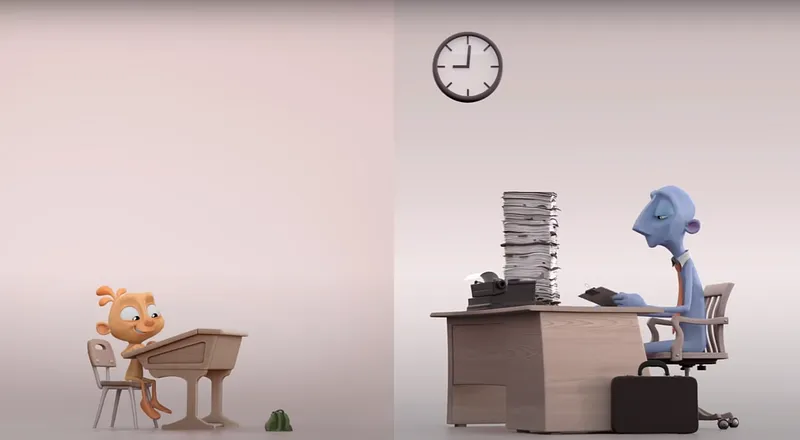
Scene from the short film Alike — https://www.youtube.com/watch?v=kQjtK32mGJQ
Here in Brazil, but also in many parts of the world, the vast majority of schools still take a 17th-century approach to education.
We want to organize, order, discipline and control the entire teaching and learning process, standardizing the development of children and young people (as if they were all the same) to turn out workers and employees who are competitive in the job market (as if that were the only or the main goal of education).
Teachers are told to get through content in a predetermined sequence, following a textbook or a workbook in order to try to make efficient a process that should be, above all, effective. It doesn’t much matter who the teacher is, only that they stick to the lesson plan and manage to “transmit” all the knowledge. Just as the traditional school ignores the differences between students, it also depersonalizes teachers.
Parents, for their part, have completely given up their participation in their children’s education. It became the schools’ responsibility alone. Everyone is far too busy working as staff or employees in the world of work. After all, that is exactly what they were so well educated for.
Companies suffer from their workers’ lack of social-emotional skills: they can’t work as a team, they struggle to resolve conflicts and they always depend on a boss’s push to get anything done (just like at school, where they always depended on the teacher to learn). These workers are hired for their rational abilities and fired for their lack of emotional skills.
Many people have already pointed out these and other problems with the traditional educational model. Authors, teachers, philosophers and other scholars have put forward alternatives and educational approaches that are inclusive and better suited to the present day. There is, however, an enormous inertia born of the fear of change, along with a sensible dose of conservatism, that prevents a complete restructuring of the educational model.
After COVID-19, however, education and schools may change forever.
The best-equipped schools are realizing that having the best physical spaces and equipment isn’t enough if the teaching method they use limits learning and the development of students’ social-emotional skills.
Holding classes over the internet with the same way of teaching used in person is making it clear how ineffective the traditional educational process is: teachers have been exposed for not having developed certain skills; workbooks and textbooks have proven limited and inefficient in this setting; parents report difficulties with the assignments sent home for their children; and students struggle because they lack the skills to self-manage their own studies.
So teachers will need to reinvent themselves (or free themselves from the traditional teaching method) and develop not only new technical skills, but also treat their students in a personalized way. Parents will need to take back their share of responsibility for their children’s education and will become increasingly aware of everything the school does with students. Students, in turn, will develop autonomy and communication skills in a way they never could have in the school of the past.
This whole extraordinary experience that the pandemic has created in the school context, lived through by teachers, students and parents, could spark a transformation in education. The school that fails to adapt will go down in history as one more victim of COVID-19.
Originally published on Medium on April 22, 2020
Let's talk
Want to bring this conversation to your organization?
Talks tailored to your audience.