Artificial Intelligence won't replace managers, it will replace switchboard operators
In this article
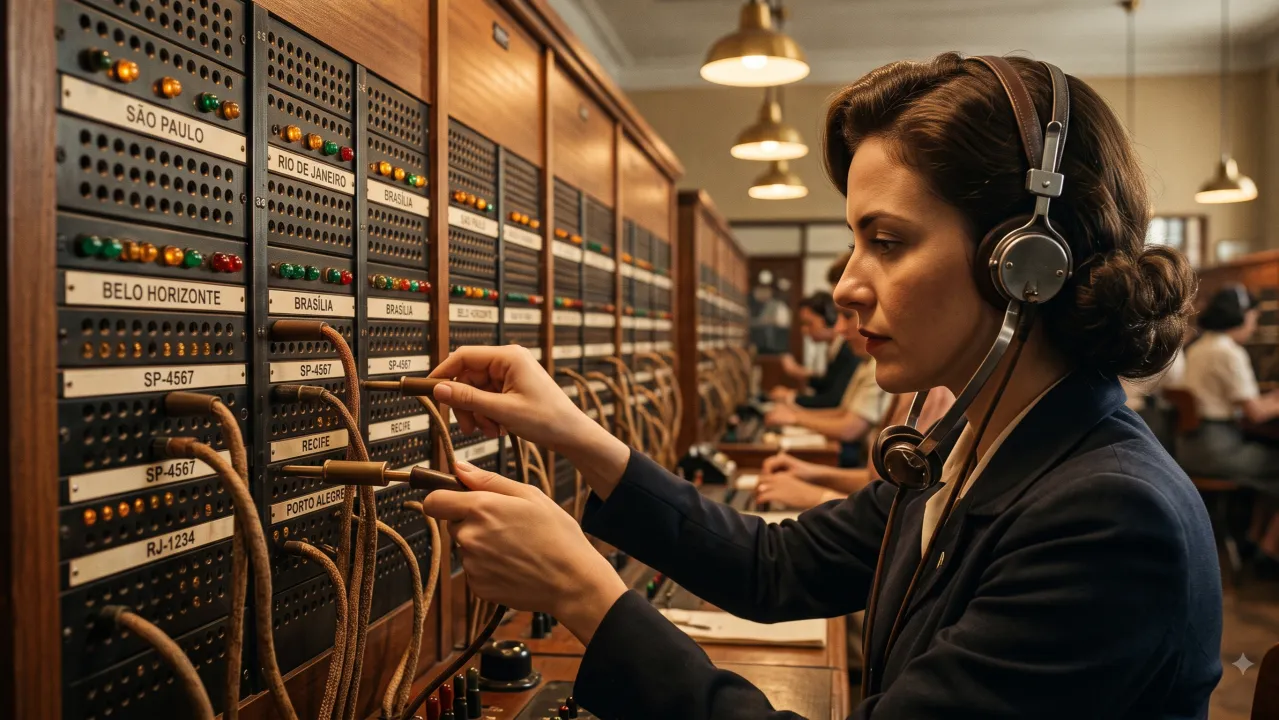
The switchboard operator of the past - Image created with Gemini (Nano Banana 2)
For much of the 20th century, if you wanted to talk to someone on the phone, you first had to talk to someone else.
The switchboard operator answered, heard the number you were looking for and fitted two plugs into a panel full of jacks. She didn’t decide what the conversation was about, and she wasn’t interested in it either. But she did something fundamental: she put the person who wanted to talk in touch with the person who was supposed to answer.
When automatic switching arrived, that job gradually disappeared. The phone kept working. It worked better.
I hold on to that image because it neatly isolates one slice of the work of management. A slice, not the whole cake. And it’s precisely this confusion between the slice and the cake that is spoiling almost every conversation about artificial intelligence and the management layer of organizations.
The difference between the manager and the switchboard operator
A good part of what a manager does during the day is take in information from one side, decide where it goes and connect the people who know with the people who need to act. Within that, two very different activities live side by side:
- Pure routing: sending the right information to the right person, recognizing patterns, distributing. That is what the switchboard operator did her whole life, without judging the content of anything.
- Embedded judgment: deciding what counts as relevant today. Reading the moment. Knowing that this request, coming from that client, after last week’s conversation, needs to jump the queue. Noticing that the person technically best suited for the task is two weeks away from burnout, and that delegating to them would be the right decision on paper but a disastrous one in real life.
From the outside, the two look like the same thing. They come in and go out through the same channel and fit in the same job description. But one is pattern recognition; the other is reading context, histories and people.
What AI does very well (and what it only seems to do)
Artificial intelligence imitates pure routing with frightening competence. A system that reads a thousand messages, summarizes, classifies, prioritizes and distributes them is doing a real slice of that work. It does in seconds what used to eat up someone’s entire morning.
If your discomfort with the relationship between AI and management comes from there, it is legitimate. That part of the work is being automated right now, and anyone who built a career based on it alone has a concrete problem.
What doesn’t give way to the same mechanism is embedded judgment. And the reason has less to do with the machine’s capability and more to do with the input it receives: the system only sees what has been recorded.
The information that an employee has been overloaded lately, that the client got irritated in the last meeting, or that a certain project has a complex political history nobody ever documented: this kind of information isn’t anywhere the system can reach.
Even so, the AI will route. Consistently, at scale and without hesitation, simply because it doesn’t know what it doesn’t know.
The cost of that doesn’t show up where it originates. It shows up two weeks later: in the person who quit, in the client who escalated the problem to your boss, in the project that fell behind without anyone being able to point to exactly which decision caused the bottleneck. Wrong routing rarely produces an immediate, visible error. It produces distributed friction, and distributed friction has no owner.
AI replacing managers?
There are headlines going around asking whether AI will replace managers. It’s a bad question, because it treats management as if it were a single thing.
The question should be a different one: how much of the coordination work in your organization is routing without judgment, and how much is judgment that merely looks like routing?
- If most of it is the former, you have an entire layer doing switchboard operator work. Automation will reveal that in an embarrassing way.
- If most of it is the latter, the switchboard operator analogy only illustrates the smaller piece. Cutting that layer in the name of “efficiency” will destroy an analytical capacity nobody knew was there, because it never showed up in any performance indicator.
The uncomfortable part is that this proportion varies from company to company, from area to area and from manager to manager. Nobody has the exact number. And yet drastic restructuring decisions are being made as if everyone did.
How to find out in your company
There is no perfect method for this measurement, but I know a pragmatic test that works.
Take the routing decisions a manager made over the last week. For each one, ask the following question: is the criterion they used documented anywhere?
- If it is, that is routing. It will probably be automated, with or without your authorization.
- If it isn’t, and they can explain the reasoning behind the decision when you ask, you’ve just found the judgment that was passing as routing.
- If they can’t give a logical explanation when asked, you’ve just stumbled onto the third and most dangerous category: operational habit. The famous ‘we’ve always done it this way’. It isn’t routing, nor is it judgment, and it will be swallowed by automation without anyone missing it.
It’s worth doing this exercise before deciding anything about the structure of your team. Because, at the end of the day, automation will make this separation for you, one way or another.
Food for thought
- How much of what your management layer does would survive if the routing criteria were strictly written down and handed to a system?
- When someone on your team makes the right call about who to send a task to, are they applying a cold rule or reading a context that no machine has any way of seeing?
Originally published on LinkedIn on August 13, 2026
Let's talk
Is your company redesigning management with AI?
Let's talk about what's at stake.