Digital transformation and AI: the hidden intelligence behind resistance to change
In this article

When a digital transformation initiative fails, the corporate reflex is to blame the technology or the teams’ supposed “lack of engagement.”
But the resistance that stalls the most ambitious projects lives in the human fabric of the organization, not in the silicon of the servers. And, contrary to what traditional management tends to preach, that resistance is not a flaw. It is the intelligent response of a complex adaptive system trying to stay alive.
Organizations behave much more like living organisms than like machines you reprogram by installing new software. Like any complex system, a company develops homeostatic mechanisms, a self-preservation instinct that maintains balance and repels foreign elements. When we introduce a technology that threatens to change the natural flow of things, the organization’s “immune system” reacts. Resistance is corporate biology doing its job.
The great blind spot of many leaders is ignoring that the current structure didn’t come about by chance. It is the expression of a very specific way of thinking about how work should happen, be controlled and be measured. Hierarchies, fiefdoms and silos divide tasks, but they also preserve the status quo. Any real transformation threatens that distribution of power, and the system organizes itself to prevent it. There’s little point in orchestrating artificial intelligence agents inside a rigid command-and-control structure. The culture smothers the technology, and the result is just a more efficient bureaucracy.
When leadership ignores this organizational biology and pushes transformation from the top down, demanding performance beyond what people can bear, the toll is paid in people’s mental health. Imposing a new digital culture without dismantling traditional power structures creates violent cognitive dissonance: people are now held accountable for agility, innovation and adapting to AI, yet they remain subject to the old control metrics. That daily friction wears down human resilience and feeds chronic stress, anxiety, depression and burnout. A transformation forced through may move a few indicators in the short term, but the human cost is high, because it destroys the psychological safety and engagement that any real evolution depends on.
If this dynamic weighs on any environment, in large corporations it reaches another scale. The immune system of these companies is much stronger and more entrenched. They have legacies to protect, enormous value chains and a natural aversion to risking the position they’ve earned.
In these environments, the force that keeps things as they are reaches beyond the office walls. There’s pressure from investors and shareholders for stability and predictability every quarter. And there’s the weight of social capital: executives and managers at these companies hold positions recognized by the market, support their families and have their standing in society tied to the current power model. Asking them to dismantle the structure that gives them security, financial stability and social prestige makes resistance much worse, because the risk stops being merely operational and becomes existential.
No organism changes because someone ordered it to. It adapts when the conditions around it change. The task of leadership, then, is to create conditions in which the system doesn’t need to defend itself against the transformation: protect what is new until it gains strength, redistribute the power that is now concentrated at the top, change what gives people prestige and ease the pressure of the short term. These are four moves I see working in large companies, each one answering one of the defenses described so far.
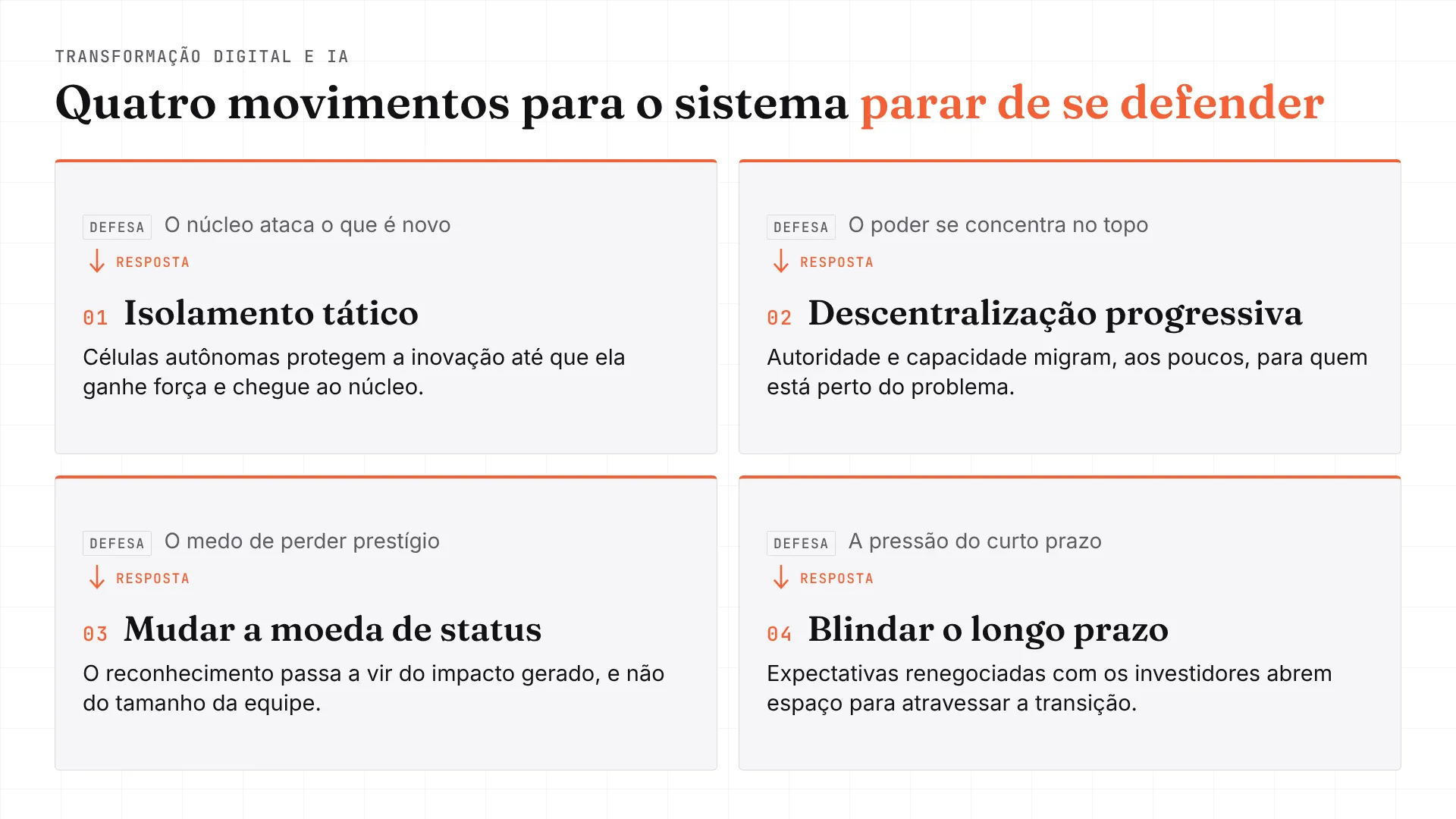
1. Tactical isolation, by creating parallel ecosystems
Instead of trying to change the hard core of the organization, where power structures will attack innovation without mercy, mature companies create autonomous cells, with their own culture, metrics and governance, to test innovations in a safe environment.
Magazine Luiza is a well-known example. In the early 2010s, the Brazilian retailer created LuizaLabs, a lab to accelerate innovation and change the way the company built software. Magalu itself describes the lab as the engine that allowed it to carry out its strategic cycle. This isolation has an expiration date, and that is part of the design. At Magalu, the lab ended up taking the center: in December 2016, the entire technology area was unified under the person who ran LuizaLabs, and by 2020 the lab had about 1,200 people and had become the company’s technology area itself.
Walmart took the opposite path. In 2017 it created Store No 8, an incubator separate from operations, and shut it down in January 2024, arguing that innovation had already spread throughout the company. In both cases, the parallel cell was a path to the core, not a place where innovation would stay forever.
2. Progressive decentralization, toward self-management
Distributing authority to the edges of the organization relieves the corporate pressure cooker. Haier is the pioneering case at large scale. Since 2005, with the RenDanHeYi model proposed by Zhang Ruimin, the Chinese manufacturer has gradually reorganized itself into a network of microenterprises. Each one makes decisions about its own business, hires its own team and defines how it allocates resources and pays its people, and along the way more than 10,000 middle-management positions were eliminated.
Repsol took a different path. Since 2018, in its Digital Program, the business areas lead their own transformation, and the IT team acts as support. More than 4,000 employees became makers and created about 25,000 bots and 600 applications. More than 5,000 people have been trained in generative AI, and today more than 34 AI agents work alongside 100 people.
Haier distributed authority; Repsol distributed capability. Both are necessary, and neither one alone completes the move.
3. Change the status currency
If resistance comes from the fear of losing recognition, the company needs to change what it rewards and decouple prestige from the number of direct reports, which is the size of the fiefdom.
The Dutch bank ING did this explicitly. In 2015, its headquarters in the Netherlands reorganized into about 350 squads of nine people, grouped into 13 tribes, and managers were no longer evaluated by the size of the teams and projects they led. From then on, software releases went from five or six times a year to once every two or three weeks. The change was not smooth. All 3,500 headquarters employees had to reapply for their jobs, the selection weighed mindset more than experience, and the new structure ended up with 2,500 people.
Changing the status currency affects the identity of those who accumulated the old one, and that cost needs to be taken care of.
4. Shield the long term
The board of directors renegotiates expectations with investors and sets a “risk budget” protected from short-term pressure.
Adobe is a good example. Before switching from boxed licenses to Creative Cloud subscriptions, in 2012, the company spent an entire day with analysts preparing the market for a drop in revenue and profit, and began reporting new metrics, such as subscriptions and recurring revenue. The stock fell 6%, less than feared, and recovered within three months. The transition had an internal cost, and not everyone stayed, but the teams were able to get through it without the quarterly demand for a result that everyone already knew would be smaller.
What AI will amplify
Adopting new tools is the smaller part of digital transformation. The bigger part is rewriting the architecture of the business, taking seriously that it is made of people, relationships and power.
AI makes this difference more expensive, because an artificial intelligence agent executes what the structure allows and amplifies what it already is. In a command-and-control organization, it speeds up bureaucracy. In an organization where authority is distributed, it expands the capacity of those close to the problem.
What the four moves have in common is that they make the system stop defending itself against change. As long as transformation is treated as an IT upgrade forced down people’s throats, it will keep triggering the defenses and making people sick.
For intelligent solutions to reach their potential, the boldness lies less in installing new processors and more in reconfiguring who decides what, trading pressure and command for the freedom that lets the organization, and the people who make it up, evolve in a healthy and sustainable way.
Food for thought
- In your organization’s last transformation initiative, was resistance treated as a people problem or as information about what the structure was protecting?
- Today, what gives a manager prestige in your company? If the answer is still the size of the team, what happens to that currency when AI agents become part of the work?
- If an AI agent started doing tomorrow whatever your structure allows, would it speed up the bureaucracy or expand the capacity of those close to the problem or the customer?
Originally published on LinkedIn on October 27, 2026
Let's talk
Is your company redesigning management with AI?
Let's talk about what's at stake.