Feedback instead of performance reviews
In this article
This text was originally published on the blog “Além da gestão tradicional” (Beyond traditional management) in March 2013.
For a few years now, I have been studying and discussing with friends how to evaluate a person’s performance at work. So far, unlike the countless methods and tools available on the market, I have come to the conclusion that it makes no sense to determine individual performance when the result of the work to be done depends more on collective performance.
The whole is greater than the sum of its parts
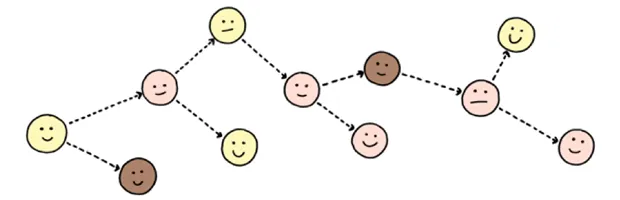
Companies are complex systems that create value for the people who are their customers. From this perspective, the capacity to generate value is divided, unevenly, among all the agents that make up this system. So performance is systemic, and none of us, individually, is responsible for the entirety of a company’s performance.
Jurgen Appelo — Empower Teams — Management 3.0
We also need to understand that a person’s performance depends on the interactions they have with the other people who work at the same company. The value placed on teamwork is just one piece of evidence of how this behavior has become more visible and important today.
However, if performance is collective and our work happens through nonlinear relationships with other people, does it make sense to set individual goals or even to measure a person’s productivity?
The pursuit of efficiency vs. innovation
Historically, performance reviews emerged in the Taylorist management model. For Taylor, managing the company should be separate from executing the work. Work would be divided into functions, and efficiency would come from improving the execution (time and quality) of each activity. Improve each part, and you improve the whole. It was therefore up to management to measure and monitor this performance, making decisions that would increase the efficiency of the work.
In that economic and industrial context, this approach worked very well. Since there was no need to innovate, since markets were stable and there were few competitors, the pursuit really was efficiency. Taylor and Ford managed to produce more cars in less time, creating the assembly line and achieving mass production (much more efficient than craft production).
Today things are very different. Markets are unstable, competition is much greater, information is available to everyone, knowledge and communication have become very important, and innovation is the only consistent differentiating factor that can keep a company competitive.
Work has become so dependent on creativity that it cannot be divided into parts or functions without some significant loss of communication and effectiveness (doing the right thing). Individually, work has also become more complex. Now it takes a group of people, a team, to work with all the knowledge available and produce an innovation that sustainably guarantees the generation of value for customers and for the business.
Individual performance
On the other hand, it is possible to identify, within the work process, some activities that are carried out individually by one person. In these cases, would it be possible to measure individual performance? Maybe so, but does it make sense? Are these the activities that generate the most value for the business?
Although these activities are very important, they tend to become commodities or even get automated by software and machines. Individual, isolated activities (those not influenced in any way by other people in the company) usually generate less value for the business in today’s knowledge economy. So it may be a waste to try to monitor the performance of these activities in the work process, since the real value lies in the innovation created from collective work.
But if it makes no sense to measure individual performance, and measuring collective performance is not that easy, what approach should we take to improve the results of a person, a team or a business?
Feedback
Taking a more systemic view, we should encourage feedback rather than evaluate the performance of a person or a team. Making clear what the negative and positive results at work are can lead the person to evaluate their own performance and improve in the direction of the business’s goals. Performance at work is a direct consequence of the actions a person takes according to the feedback they receive from the environment they are in.
In this way, a person can improve their performance at work by receiving feedback from the other members of their team, changing their behavior and seeking new knowledge.
On the other hand, a team can improve its performance by receiving feedback from customers (in terms of value creation) and feedback from the company (in financial terms), improving its products, its processes and the way it does management.
Through feedback, we can become aware of how an agent affects a complex system and determine how we can evolve. Improvement should be reflected in changed behavior and in the collective capacity of the system’s agents to generate different (preferably better) results.
Replacing individual performance reviews
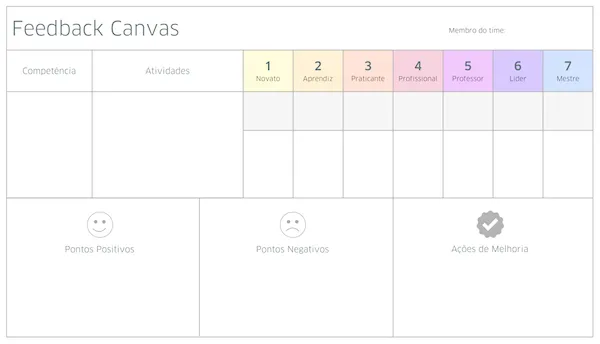
To abandon individual performance reviews, we need an effective way to encourage individual feedback within the context of a team. The Feedback Canvas is a tool we created at Webgoal to help with this transition.
The goal of this tool is to structure, guide and support the feedback process within the context of teamwork. Its dynamics create an environment of trust so that a team member can receive feedback from their peers.
The following presentation shows how to use the Feedback Canvas to run a feedback session:
In this video, I also show how to use this feedback tool and explain in more detail how to adopt it in companies or teams:
Download the Feedback Canvas print file and try it with your team, starting with yourself.
Originally published on Medium on April 4, 2018
Let's talk
Is your company rethinking its management model?
Let's talk about what makes sense for where you are now.