The four indices of Cognitive Coherence at work
In this article

Image created with Gemini (Nano banana 2) — 4 P-O Fit indices
I defined “Cognitive Coherence” as the functional compatibility between the individual’s cognitive architecture and the organization’s architecture of power and communication, and I argued that it operates along two simultaneous dimensions: the degree of autonomy the environment demands and the mode of coordination the work imposes. These two dimensions form the axes of the P-O Fit Matrix (Autonomy × Coordination).
Articles on Cognitive Coherence and the P-O Fit Model
To better understand the context of this text and the concepts of Cognitive Coherence and Person-Organization Fit, I recommend reading these articles:
- When a person doesn’t fit their work
- Cognitive Coherence: when the way you think, decide and act meets the way you work
- The difference between a group and a team and the invisible cost of coordinating work
What was still missing, however, was to show how this concept becomes measurable. In the P-O Fit approach I am proposing, that translation happens through four operational indices that, together, describe where a person is positioned on the matrix and how deeply they sustain that position.
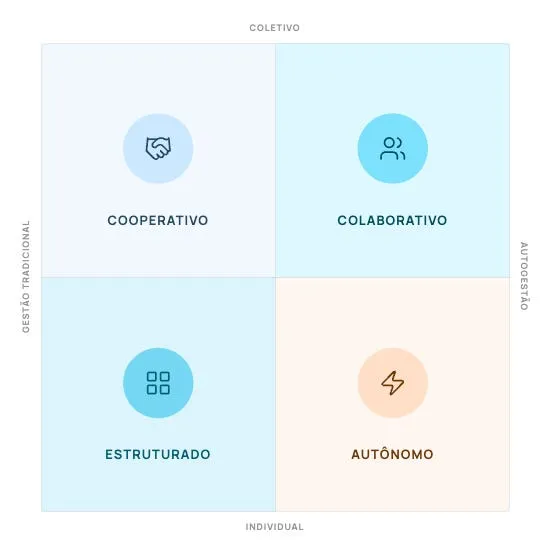
P-O Fit Matrix: Autonomy x Coordination
Positioning indices
These are the ones that determine where the individual is located on the P-O Fit Matrix:
- The Readiness for Autonomy Index (IPA) defines the X axis.
- The Social and Ethical Intelligence Index (IISE) defines the Y axis.
These two indices answer the question “in what kind of environment does this person thrive?”.
Qualifying indices
These are the ones that describe how robustly the individual sustains that position:
- The Resilience and Cognitive Load Index (IRCC) qualifies the emotional sustainability of the profile under pressure.
- The Cognitive Processing Index (IPC) qualifies the operational processing style and captures the neurodiversity layer of the model.
These two indices answer the question “how deeply, and with what kind of support, does this person need to thrive in the identified environment?”.
This distinction matters because a diagnosis based on positioning alone ignores the sustainability of the fit. A person can be correctly positioned in a self-management environment and still suffer an operational collapse if the IRCC or the IPC point to weaknesses that the design of the work does not address.
Readiness for Autonomy Index (IPA)
The IPA measures the individual’s functional capacity to operate without direct supervision. It is not about measuring whether the person “likes” autonomy, but whether they can, in practice, sustain quality work when no one tells them what to do or how to do it.
The index brings together three facets. The first is locus of control, Rotter’s (1966) classic construct that distinguishes people who attribute causality to internal factors (their own decisions and effort) from those who attribute causality to external factors (luck, bosses, circumstances). The second is self-discipline, the capacity to sustain focus and cadence without the need for external pressure. The third is intrinsic proactivity, the internal drive to initiate improvements and changes instead of waiting for orders or permission.
The main theoretical anchor comes from Deci and Ryan’s (2017) Self-Determination Theory, which identifies autonomy as one of the three basic psychological needs for intrinsic motivation. The IPA is, ultimately, a measure of dispositional readiness to exercise that need in the context of work.
In this P-O Fit model, the IPA defines the X axis of the matrix. High scores indicate suitability for self-management environments. Low scores indicate that the individual operates better in contexts with more explicit direction, well-defined roles and a clear chain of command. Neither extreme is superior. Each corresponds to a distinct organizational configuration.
Social and Ethical Intelligence Index (IISE)
The IISE measures the individual’s orientation toward interpersonal coordination and informational transparency. It was the concept developed in the previous article, articulated in three characteristics: social agreeableness (the preference for, and energy toward, collective interaction), ethical integrity (the willingness to proactively share information) and systemic empathy (the proactivity to help peers without orders from above).
The theoretical anchoring is threefold. The Agreeableness dimension of the Big Five (Costa & McCrae, 1992) supports the overall construct. Edmondson’s (1999) concept of Psychological Safety anchors the transparency characteristic, since open-information environments are both a cause and a consequence of psychological safety. The literature on lateral coordination in decentralized systems, particularly the work of Martela and Nandram (2025) on the Buurtzorg model, grounds the systemic empathy characteristic.
The IISE defines the Y axis of the matrix. High scores place the individual on the collaborative-interdependent end of the spectrum. Low scores indicate a preference for independent work or group work with low interdependence. As I argued in the previous article, the social dimension cannot be reduced to sociability: it also includes the willingness to operate in open-information systems. A highly sociable individual who holds back strategic information operates in a qualitatively different way from someone equally sociable who is also transparent.
Resilience and Cognitive Load Index (IRCC)
If the IPA and the IISE say where a person is, the IRCC says how emotionally sustainable it is for them to stay there. The index measures the capacity to maintain operational effectiveness and emotional balance under uncertainty, bringing together: tolerance for ambiguity (the capacity to operate without a manual or a single criterion for what is correct), ownership (the sense of responsibility and stability under pressure) and cognitive openness (the willingness to revise one’s own position in the face of better arguments).
The theoretical anchoring is multiple. With respect to the Big Five, the IRCC correlates inversely with Neuroticism (Costa & McCrae, 1992): people with a high IRCC tend to show low emotional instability. The index also connects with the classic literature on tolerance for ambiguity (Budner, 1962; McLain, 1993; Lauriola et al., 2016) and with Kruglanski and Webster’s (1996) concept of the need for cognitive closure.
Functionally, the IRCC qualifies the robustness of any position on the matrix. An individual can have a high IPA, which indicates readiness for autonomy, and still show a low IRCC. That profile reveals autonomy that is real but fragile: the capacity to operate without supervision under stable conditions, but vulnerability to collapse when ambiguity or pressure rise significantly. Identifying that fragility is what allows the organization to design the right support instead of simply placing the person in a formally compatible role.
Cognitive Processing Index (IPC)
The IPC is the most distinctive index in the model and the one most connected to the neurodiversity literature. It measures how the individual organizes, executes and sustains work at the operational level, bringing together three perspectives: functional versatility (the capacity to move between roles and learn new skills), focused attention signature (the individual’s attentional pattern, including sensitivity to stimuli in the environment) and self-knowledge of one’s productive rhythm (clarity about one’s own cognitive flow and the conditions under which it works best).
The theoretical foundation draws on different ideas. The versatility perspective connects with the Openness to Experience dimension of the Big Five. The attentional signature and rhythm self-knowledge perspectives speak directly to the neurodiversity literature from a strengths-based perspective (Doyle, 2020; CIPD, 2024), which recognizes patterns such as hyperfocus, sensory sensitivity, energy that comes in peaks and the need for structuring rituals not as deficits, but as legitimate processing styles that require compatible environments.
This is where the P-O Fit model sets itself apart most clearly from conventional assessment tools. Traditional psychometrics tends to treat these patterns as noise or as signs of pathology. Here they are treated as relevant diagnostic information: indicators that the work environment needs to offer certain kinds of support, such as asynchronous communication, protection of hyperfocus, uninterrupted flows or work in short blocks with structured breaks.
Functionally, the IPC is the primary index for what I call Universal Design flags, recommendations for environmental support that make work accessible to diverse cognitive profiles without pathologizing them.
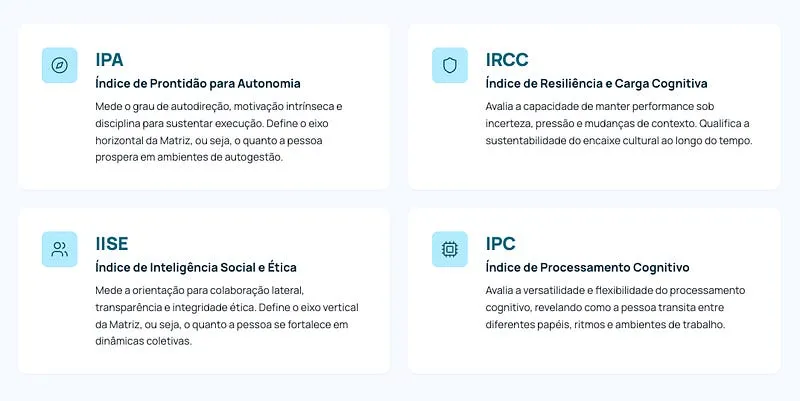
The four positioning indices on the P-O Fit Matrix.
The combination matters more than the indices in isolation
The risk of any diagnostic instrument is reductionism: treating a number as the definition of a person. This P-O Fit model was designed precisely to resist that risk. None of the four indices, on its own, describes someone’s profile. It is the combined configuration of all four, read in layers, that makes up the diagnosis.
Think of four individuals with a high IPA. All of them would, in theory, thrive in self-management environments. But:
- If one of them has a high IRCC and a high IPC, they sustain autonomy even under high complexity, with the functional versatility to move between roles.
- If another has a low IRCC and a high IPC, they sustain autonomy under stable conditions, but need emotional support or a reduction of uncertainty at critical moments.
- If a third has a high IRCC and a low IPC with a focused attention signature, they sustain autonomy, but need protection of hyperfocus and uninterrupted flows.
- If a fourth has a high IISE, they thrive in collaborative, interdependent self-management. If they have a low IISE, they thrive in independent self-management, with autonomy over method and results, but without a demand for intense coordination.
These are four profiles with the same “autonomy score” that call for completely different work designs. Reducing any of them to a single number would mean losing exactly the information that is most useful to the organization and to the individual themselves.
In the next article, I will show how this combined configuration of the four indices translates into a position on the P-O Fit Matrix and produces the 16 profiles the model identifies, each with its own Place of Potential, ideal environments and specific disengagement risks.
Something to reflect on
When you read the descriptions of the four indices, which one do you imagine is your greatest strength? And which one do you believe would need the most environmental support for you to sustain it?
And looking at your organization, does it measure, or at least talk about, any of these dimensions in its processes for hiring, placing and developing people? Or does it keep assessing “profile” and “cultural fit” only at the level of declared values?
Originally published on Medium on June 8, 2026
Let's talk
Are the right people in the right places in your company?
Let's talk about how to diagnose that coherence.