The P-O Fit Matrix and the 16 Places of Potential
In this article

Image created with Gemini (Nano banana 2) — 16 places of potential
In the previous article, I presented the four indices that turn Cognitive Coherence into a diagnosis: two positioning indices (the Readiness for Autonomy Index and the Social and Ethical Intelligence Index) that determine where the individual stands on the P-O Fit Matrix, and two qualifying indices (the Resilience and Cognitive Load Index and the Cognitive Processing Index) that describe how deep that positioning goes and under what conditions it holds. What was still missing was to show how this configuration translates into something concrete and actionable for people and organizations.
Articles on Cognitive Coherence and the P-O Fit Model
To better understand the context of this text and the concepts of Cognitive Coherence and Person-Organization Fit, I recommend reading these articles:
- When a person doesn’t fit their work
- Cognitive Coherence: when the way you think, decide and act meets the way you work
- The difference between a group and a team and the invisible cost of coordinating work
- The four indices of Cognitive Coherence at work
That is the purpose of the P-O Fit Matrix (Autonomy × Collaboration): to translate the four indices into a positioning map and, within each region of that map, to identify 16 power profiles that describe the typical configurations in which distinct cognitive architectures meet compatible environments.
What a Place of Potential is
Before presenting the profiles, it is worth clarifying what the model is classifying. Unlike instruments such as MBTI or DISC, which classify personality types, P-O Fit does not tell you “who you are”. It tells you where you thrive.
This difference is fundamental. Personality types carry an implicit promise of stability and essence: you are introverted, intuitive, judging, and that describes something about your psychological core. A Place of Potential, on the other hand, describes a relationship: the environment in which your cognitive architecture meets compatible demand, and therefore produces with maximum effectiveness and minimum strain.
A Place of Potential is therefore always a relationship between person and context, not an isolated property of the individual. This has three practical implications. First, no one is better or worse for occupying this or that profile: the hierarchy of value is horizontal, not vertical. Second, the profile describes where a person performs best, but it does not prevent them from operating in other contexts, at a higher energy cost. Third, the profile can evolve over a professional life, as experiences reshape the cognitive architecture, although the core tends to remain stable.
The order of precedence within each quadrant
Within each of the matrix’s four quadrants, the model places the individual in one of four profiles, following a fixed order of precedence:
- Exponential Potential: Profiles with exceptional scores across multiple indices or blocks, often associated with patterns of high ability or giftedness. These are highly complex cognitive architectures that need specific environments in order not to stagnate.
- Processing Nuance: Profiles with distinct cognitive signatures, detected through specific divergences between blocks. Typically associable with functional patterns of ADHD, ASD or an explicit need for executive support, treated here as legitimate processing styles.
- High Typical: Profiles with high performance within the quadrant, with no exceptionality or divergence triggers. These are robust, balanced architectures for the kind of environment the quadrant defines.
- Typical: The quadrant’s base profile, assigned when no specific trigger is activated. It is not an “inferior” profile; it is the quadrant’s point of balance, where most people tend to land.
The algorithm guarantees exclusivity: each person receives exactly one profile. When multiple conditions seem to be met, tiebreaker criteria determine the final assignment. The hierarchy describes only the order in which the conditions are tested, not an order of value: a Typical in Q1 is worth no less than an Exponential Potential in Q4.
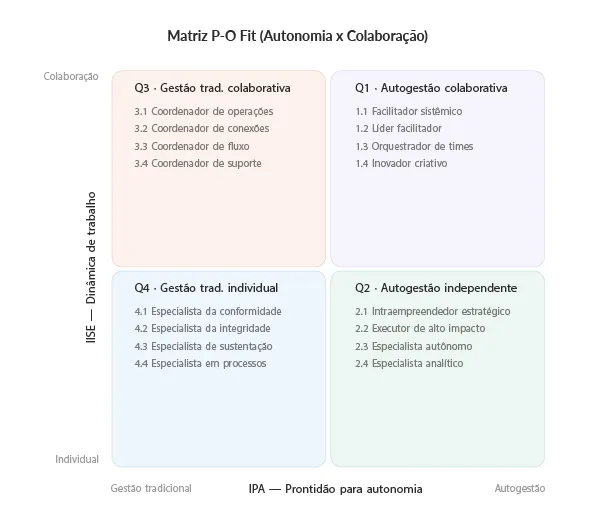
The P-O Fit Matrix and the 16 profiles that determine the places of potential
Quadrant 1 — Collaborative Self-Management
People in Q1 combine high readiness for autonomy with a strong social and ethical orientation. In mature self-managed organizations, this is the quadrant with the highest expected prevalence, because it brings together individuals who not only operate without supervision but actively build the social systems around them.
1.1 Systemic Facilitator (Exponential Potential). Sees the organization as a living system, with feedback loops and leverage points that others don’t notice. The invisible architect, governance designer and mediator of strategic tensions.
1.2 Facilitating Leader (High Typical). Leads self-managed teams with a firm, steady presence, facilitates critical decisions and keeps the group cohesive through change. Unlike the traditional manager, their authority comes from the ability to build consensus, not from a position of power.
1.3 Team Orchestrator (Typical). Keeps team dynamics in sync. Works on lateral coordination, group cohesion and the upkeep of alignment rituals. Often the one who keeps the team working as a team rather than as a sum of individuals.
1.4 Creative Innovator (Nuance, associable with functional patterns of ADHD). Intense creative energy in nonlinear cycles, high ideation under pressure and difficulty with prolonged operational follow-through. Thrives in sprints, launches and brainstorms, and needs explicit environmental support for the organizing and finishing phases.
Quadrant 2 — Independent Self-Management
People in Q2 also have high readiness for autonomy, but they prefer to operate independently, with less need for continuous social interaction. This is not a social deficit, but a functional orientation toward deep work, individual delivery and direct technical impact.
2.1 Strategic Intrapreneur (Exponential Potential). A frontier explorer with a multipotentialite profile. Moves between the technical and the strategic, learns new domains at a speed far above the curve and opens unprecedented fronts of innovation. The main risk is boredom when confined to static roles.
2.2 High-Impact Executor (High Typical). The classic intrapreneur who makes things happen independently. Takes calculated risks, manages their own time with discipline and consistently delivers measurable results. Doesn’t need constant new intellectual stimulation: needs clear responsibility and objective metrics.
2.3 Autonomous Specialist (Typical). Consolidated mastery of the craft, a refined method of their own and end-to-end delivery. Stability and reliability are their assets. The professional the organization knows it can count on to sustain long-term technical delivery without needing to be monitored.
2.4 Analytical Specialist (Nuance, associable with functional patterns of ASD). Very high transparency and integrity combined with a lower orientation toward relational diplomacy. The team’s logical anchor, detects patterns and inconsistencies that others miss. Thrives in deep analysis, asynchronous communication and environments with low sensory noise.
Quadrant 3 — Collaborative Traditional Management
People in Q3 combine low dispositional readiness for autonomy with a strong social and collaborative orientation. This is not a lack of ability, but an architecture that performs best when operating within a clear structure, with defined leadership and explicit roles, while drawing significant energy from the social dimension of work.
3.1 Operations Coordinator (Exponential Potential). Exceptional emotional and systemic sensitivity. “Reads the room” in any environment, identifies hidden power dynamics and anticipates interpersonal crises before they surface. Thrives in strategic HR, Customer Success, community mediation and cultural facilitation.
3.2 Connections Coordinator (High Typical). A natural promoter of organizational culture. Sustains morale, loyalty and belonging, with energy directed toward integration and welcoming. The one who makes sure new people quickly feel they belong and that team rituals stay alive.
3.3 Flow Coordinator (Typical). A pragmatic organizer who turns big goals into executable schedules. Brings security to the team through organization: deadlines, owners and metrics. Thrives with clear goals, defined plans and well-delimited roles.
3.4 Support Coordinator (Nuance, associable with a need for executive support). Helpful and collaborative, but needs external infrastructure to organize their own energy. Flourishes with predictable rhythms and linear demands. When the environment provides structure, contributes with rare generosity. When it doesn’t, scatters across multiple fronts.
Quadrant 4 — Individualized Traditional Management
This quadrant is often misunderstood, so it is worth starting with what it is not. People in Q4 are not “less capable”. They combine lower dispositional readiness for autonomy with a lower social orientation, and their Place of Potential lies in precise technical execution, operational rigor and compliance. These are essential functions for any organization to work, especially where precision and stability have real strategic value.
4.1 Compliance Specialist (Exponential Potential). Guardian of technical and regulatory integrity. Combines transparency at the highest level of all 16 profiles with equally high management of ambiguity. Works in high-complexity security, audit and compliance systems, and thrives in environments that value unbending rigor.
4.2 Integrity Specialist (High Typical). Methodical, watches over order and operational quality. Feels genuine satisfaction in making sure everything is “by the book” and takes on long-term operational responsibilities with constancy. Often the silent pillar of areas that depend on consistency.
4.3 Sustainment Specialist (Typical). A quiet worker, vital to operational continuity. Stability, constancy and predictability are their assets. Doesn’t seek the spotlight, doesn’t compete for visibility, and that is precisely what makes them essential in areas where errors are costly.
4.4 Process Specialist (Nuance, associable with functional patterns of sequential processing and ASD). Deep processing in linear flows, high concentration on logical sequencing, low tolerance for fragmentation or multitasking. Reaches full power on sequential tasks carried out from start to finish, with protected hyperfocus and a predictable environment.
Neurodiversity as a functional signature
One aspect worth highlighting is how the P-O Fit model treats neurodiversity. Four of the 16 profiles (the Nuances of each quadrant: Creative Innovator, Analytical Specialist, Support Coordinator and Process Specialist) capture patterns often associable with conditions such as ADHD, ASD and a need for executive support. But the model works on observable organizational behaviors, not on clinical diagnoses. What it identifies is not the presence or absence of a neurological condition, but a functional signature: a stable pattern of how the individual processes, executes and sustains their work.
This choice has a practical consequence. Instead of pathologizing differences, the model treats each signature as relevant diagnostic information: an indication that the work environment needs to offer certain supports for that cognitive architecture to operate fully. Hyperfocus, asynchronous communication, protection from interruptions, visual organization, nonlinear work cycles: all are recognized as legitimate Universal Design needs, not as concessions to weaknesses.
The reverse consequence matters too. Recognizing cognitive signatures avoids the common mistake of treating differences as symptoms to be corrected. An Analytical Specialist doesn’t need to “learn to relate better” to become an Operations Coordinator. A Creative Innovator doesn’t need to “learn to get organized” to become a Systemic Facilitator. Each has a Place of Potential of their own, and the organization’s task is to design work so as to make use of that diversity, not to standardize it. The theoretical foundation of this approach lies in the strengths-based perspective on neurodiversity (Doyle, 2020; CIPD, 2024).
A Place of Potential is not a prison
Let me close with an important caveat to avoid deterministic readings. A profile identified by the P-O Fit model describes a person’s main Place of Potential, that is, the environment where their cognitive architecture meets compatible demand. But that does not mean they are confined to that profile or unable to move into adjacent Places.
A person can spend much of their career in their main Place of Potential and still develop the skills to work in neighboring quadrants, at a higher energy cost. A person can also move between Places over the course of their life, as experiences reshape their cognitive architecture. The model is not a sentence, it is a map: it shows where the journey is most natural, without forbidding the other routes.
In the next article in the series, I will show how this P-O Fit model translates these 16 profiles into four distinct onboarding models, showing that bringing a person into an organization is not a single process, but needs to be designed around the profile of whoever is arriving.
Something to reflect on
Think of someone on your team, in your organization or along your professional path whose performance seemed inexplicably uneven. As you read the descriptions of the 16 profiles, can you picture which quadrant that person would fit into most comfortably? And how far is that quadrant from the environment they are in today?
Now turn the question to yourself. If you had to choose one of the four quadrants as your main Place of Potential, which would it be? And is the environment you work in today coherent with that choice, or does it demand a way of operating that carries a higher energy cost than you would like to pay every day?
Originally published on Medium on June 30, 2026
Let's talk
Are the right people in the right places in your company?
Let's talk about how to diagnose that coherence.