The mysterious Golden Legend of Saint James
In this article
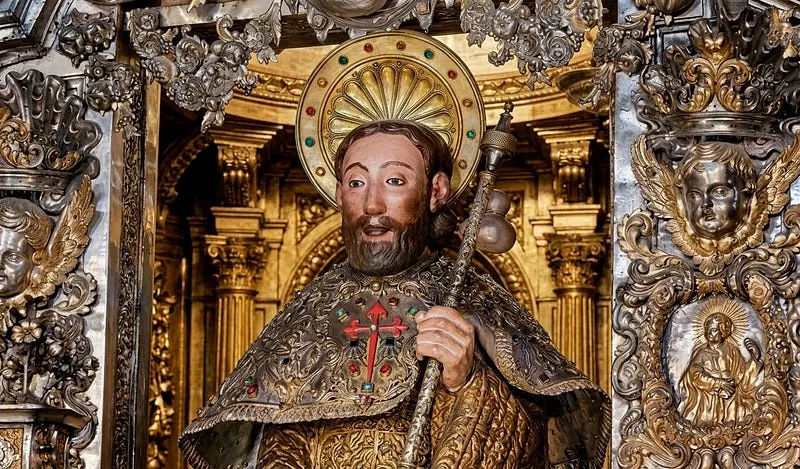 The apostle Saint James on the high altar of the Cathedral of Santiago de Compostela, Galicia.
Anyone walking to Compostela ends up noticing something around the third or fourth day. The scallop shell is everywhere. It is painted on the stone markers along the road, engraved on the metal of street signs, hanging from the backpack of the pilgrim just ahead, carved into the portals of Romanesque churches… And nobody really knows why a seashell became the symbol of a walk that crosses mountains and dry plateaus, hundreds of kilometers from the sea.
The answer lies in a story that pilgrims heard in the hostels and monasteries along the way, told out loud, night after night, for centuries. It is the Golden Legend of Saint James, the account of how the body of an apostle beheaded in Jerusalem ended up at the far edge of the European continent. It took shape in the 12th century, and the name it came to be known by came from the collection of saints’ lives that was put together a few decades later.
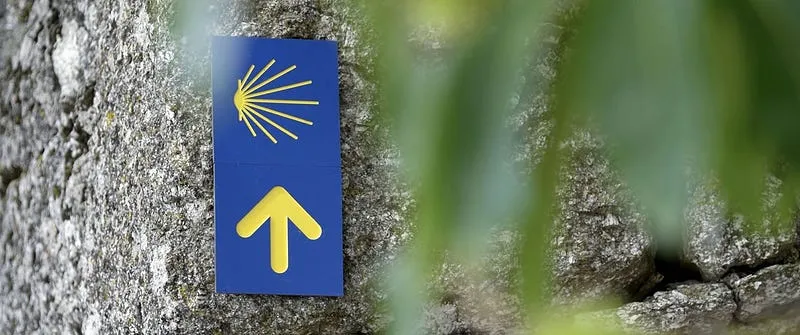
But the shell has a story, and so do the star that gives Compostela its name, the staff the pilgrim carries, the goose that shows up in dozens of place names along the route and even the “she-wolf” who receives the apostle’s body in the medieval version of the legend. Each of these elements came from somewhere, and several of them came from a world older than Christianity.
That is what makes the legend so interesting. It is a Christian story told on top of much older layers that have not disappeared. They are still there, visible to anyone who knows how to look.
Going through the legend carefully changes the experience of the pilgrimage, because the road stops being just scenery and becomes history.
The story of Saint James
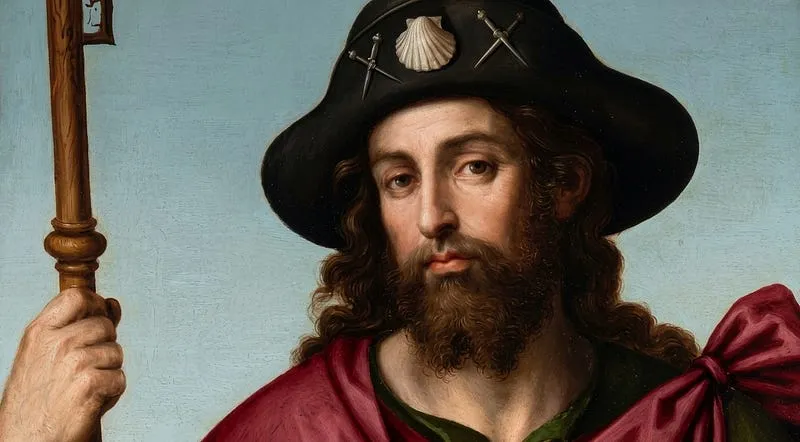 Saint James the Pilgrim, by Juan de Juanes — Museo de las Peregrinaciones y de Santiago
James, son of Zebedee and brother of the apostle John, was a fisherman in Galilee when Jesus called him. He became one of the three disciples of the innermost circle, the group that was present at the Master’s most private moments.
The two brothers were known for their fiery temper, and the nickname Jesus gave them came from a specific episode. When they arrived at a Samaritan village that refused to receive them, James and John offered to call down fire from heaven to consume it. Jesus rebuked them: “Ye know not what manner of spirit ye are of”. From this came the Greek name Boanerges, sons of thunder or sons of fire.
The nickname already holds the tension that runs through the character: the preacher would also become the knight with a flaming sword. Fire returns both in the episode of the dragon and in the alchemical reading of the legend.
It is worth pausing on the name before moving on. Iacobus, the Latin form of the Hebrew Jacob, lost its ending in the west of the Peninsula and became Iago. Santo Iago became Sant’Iago, then São Tiago. The same Iacobus became James in English and Jacques in French. And the builders who opened the roads and raised the medieval cathedrals in France were called precisely Jacques. The apostle and the stonemasons shared the name long before they shared the route.
Tradition says that after Christ’s death the apostles divided the regions of the world among themselves to carry the new faith. James was given the far west, the edge of the known world at the time, the place where the sun set and beyond which there was only ocean: the Iberian Peninsula.
The mission that failed
The preaching in Hispania was a failure. James is said to have landed on the Mediterranean coast of Andalusia, in the lands of ancient Tartessos, and taken the Roman road that ran through Emerita Augusta, Conimbriga and Bracara Augusta toward the interior of Gallaecia, ending in Iria Flavia. The Portuguese tradition adds a stretch and claims a primacy: the apostle would have passed through Coimbra, Rates, Póvoa de Varzim, Guimarães and Braga, which would make the Portuguese itinerary the first of all the Jacobean routes.
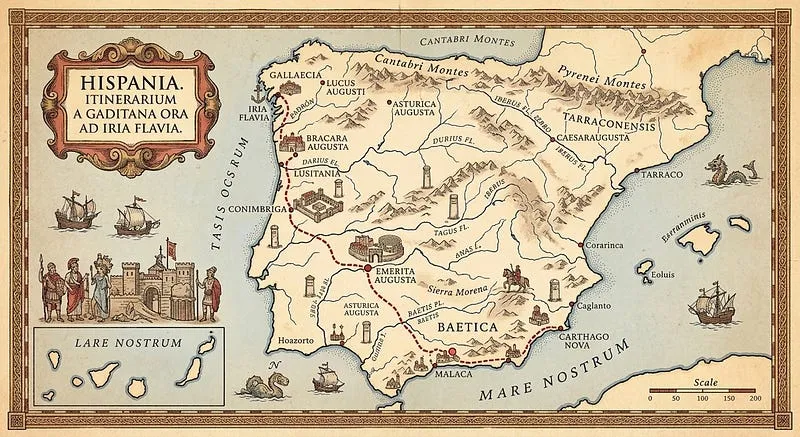 Possible route taken by the apostle James on the Iberian Peninsula
He persevered for seven years and gathered little. The versions disagree on how many disciples he managed to win over: some say seven, others nine, others twelve. There is a curious detail: they say the apostle traveled with a dog, an animal more receptive to his word than the pagans themselves.
And there was something he kept leaving along the way. He carried in his saddlebags images of the Virgin brought from Palestine and handed them out wherever he went. When they ran out, he ordered more from local craftsmen.
It was at the bottom of this discouragement that the two most beloved Marian episodes of the tradition took place.
The first happens in Galicia, on the wild coast of Muxía. They say that, seeing the apostle downcast, the Virgin Mary came to meet him sailing in a stone boat steered by angels. After encouraging him, the boat turned to stone right there, and part of it would be the Pedra de Abalar, an enormous block that still rocks by the sea today.
That stone was already used in fertility rites long before any Christian set foot in Galicia. The Christian legend settled right on top of a pagan sanctuary and made no effort at all to hide it.
The second episode happens further inland, in Caesaraugusta, today’s Zaragoza, on the banks of the Ebro. It is said that in the early hours of January 2 in the year 40, while James was praying with his few disciples, they heard the voices of angels singing the Ave Maria. Before them, on a jasper column, the Virgin appeared.
What makes these apparitions unique is that Mary was still alive, in Jerusalem, when she appeared. She was the mother of Christ in mortal flesh, appearing thousands of kilometers from where she actually was, and that is why tradition considers them the first Marian apparitions in history.
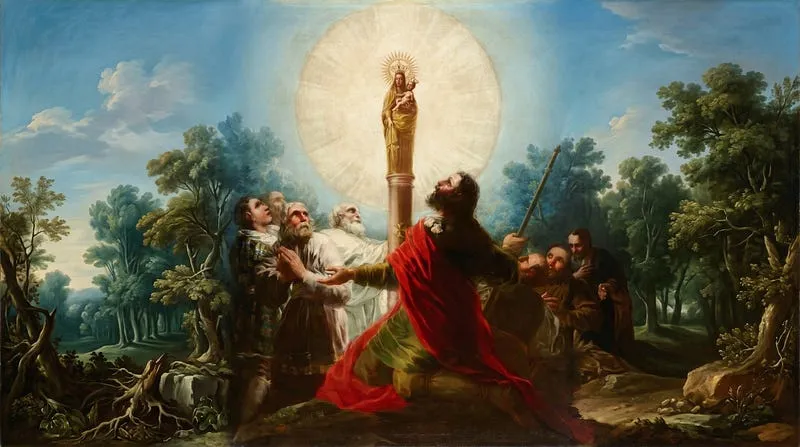 The apostle James and his disciples adoring the Virgin of the Pillar — Francisco de Goya, 1775–1780
Mary is said to have comforted the apostle, asked him to build a church there and left the stone pillar as a sign. From this came the devotion to the Virgen del Pilar, still one of the most beloved in Spain.
Some versions place this apparition during the preaching, others already on the way back. And some versions even give the Virgin’s age at that encounter: fifty-five years and three months. The detail is worth less as information than as a symptom. A legend that gains this degree of precision is a legend that has already been told many times, by many people willing to fill in the gaps.
Notice what the two miracles have in common. A boat that turns to stone, a column that stays behind as a mark. The golden legend likes stones that hold the sacred. It is the seam between the Christian world and a much older one, made of menhirs and dolmens that were already receiving offerings when no one there had ever heard of apostles.
The duel with the magician
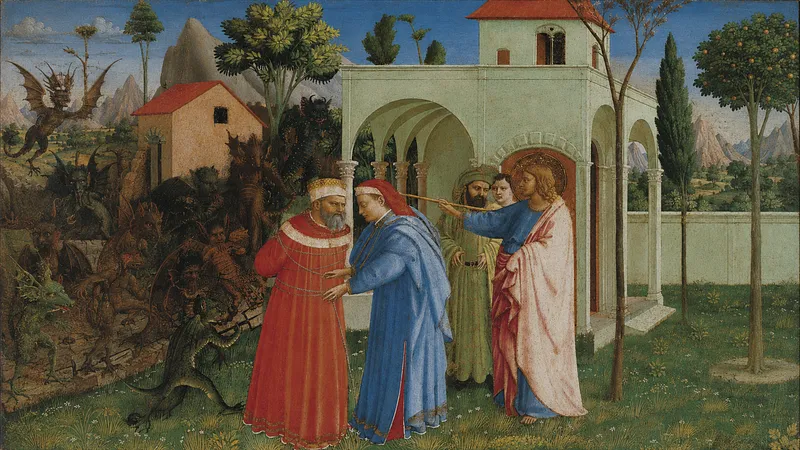 The apostle Saint James the Greater freeing the magician Hermogenes — Fra Angelico
Comforted by the apparitions, but still without lasting results, James went back to the Holy Land. It was there that one of the most forgotten episodes of the legend took place.
The apostle clashed with a magician named Hermogenes, in a duel of powers that seems to come out of an ancient tale. Hermogenes sent his disciple Philetus to confront James, and Philetus ended up converted. Angry, the magician bound him with spells, leaving him unable to move. James then sent his own cloak to the prisoner, with a formula for him to recite: God lifts up those who have fallen; He frees those who are captive. Philetus got up and went to meet the apostle.
Seized with rage, Hermogenes summoned demons to bring the two of them to him by force. The demons came back, but in chains. They said that, on the way, the Angel of the Lord had bound them with iron chains, and they begged to be released from that torment. Instead of capturing the apostle, they tied up the magician himself, hand and foot, and handed him over.
Defeated, Hermogenes converted, but remained terrified of revenge from the demons he used to command. James gave him his own staff as protection.
Pay close attention to this gesture, because it is the first appearance of the pilgrim’s staff in this story, and there it is not a walking aid. It is an object of defense handed by an apostle to a converted magician.
Only then did the magician offer to burn his books of magic. James refused the bonfire, worried that the smoke would draw too much attention, and had them thrown into the sea.
The names of the two adversaries say what is at stake. Hermogenes means “born of Hermes”. Philetus means “beloved”. Together, they are followers of Hermetic philosophy. The apostle does not destroy Hermeticism in that encounter. He converts it and puts it to work on his side.
It is a small episode, but it reveals the tone of the whole legend. James wins by transforming his adversary, not by destroying him. This is the way the narrative absorbs the clash between two kinds of knowledge.
The martyrdom and the rudderless boat
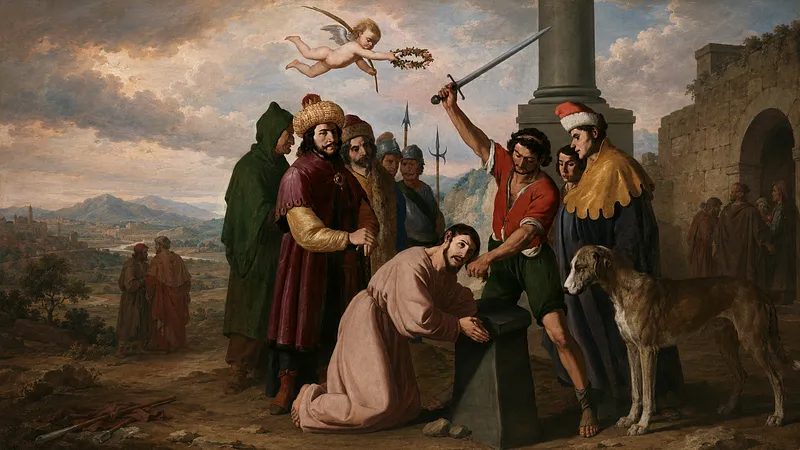 Martyrdom of James — Francisco de Zurbarán, 1640
Shortly afterward, back in Jerusalem, the apostle was beheaded on the orders of Herod Agrippa, around the year 44. He became the first of the twelve to die a martyr and is the only one whose death the New Testament records. On the way to his execution, a paralyzed man asked for his help and James healed him right there, bound and on his way to death. Josias, the Pharisee who was leading him, saw the miracle, converted, was baptized by the prisoner himself and ended up beheaded alongside him.
The two bodies were thrown into the fields for dogs and wild beasts to devour. Under cover of night, two disciples gathered the apostle’s body and head and fled toward the sea. They took him to the port of Jaffa and placed him in a boat with no rudder, no sail and no oars, left to divine providence.
With no one choosing the course, guided by angels, the boat set off westward, in the same direction souls take toward the Beyond. It crossed the Mediterranean, passed the Pillars of Hercules (the Strait of Gibraltar) and entered the Dark Ocean (the Atlantic Ocean). After seven days, or a single night depending on the version, it entered the Ría de Noia and stopped near Iria Flavia.
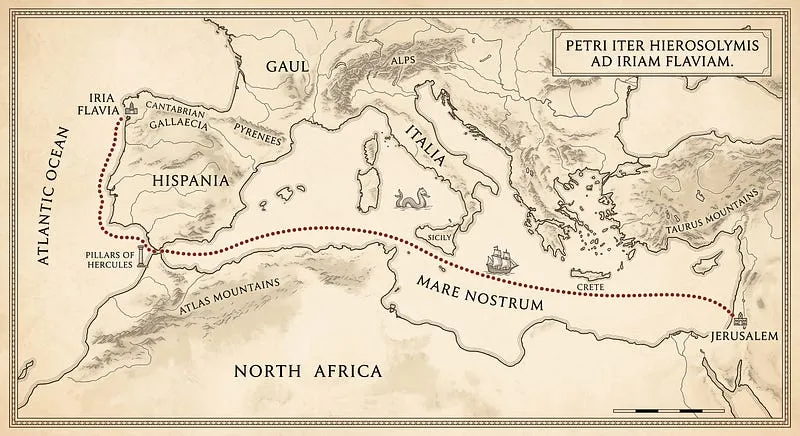 Route taken by the boat carrying the body of the apostle James and his disciples
The disciples jumped ashore and moored the boat to a large stone, a pedrón in Galician. Only the stone was not just any stone. It was a Roman ara, a votive altar linked to the old port of Iria Flavia, and the inscription that remains on it points to Neptune.
The boat guided by angels came to rest precisely against the altar of the god of the sea. Over time, people swapped the Latin name for Pedrón, then Padrón, and the marker ended up in the Church of Santiago de Padrón.
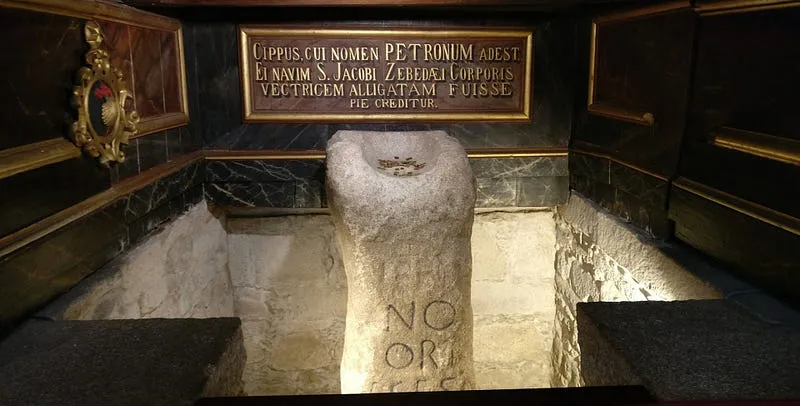 The pedrón, on the high altar of the Church of Santiago de Padrón.
There is even a saying: “Quen vai a Santiago e non vai a Padrón, ou fai a romaría ou non” (whoever goes to Santiago and doesn’t go to Padrón has either made the pilgrimage or hasn’t).
Look at the course of this voyage. It goes from east to west, from sunrise to sunset, crossing the entire Mediterranean only to run aground precisely at the end of the continent. No boat adrift would make that journey.
The legend also makes a point of telling us what was in the sky when the boat arrived. Over that coast stood out the constellation of Canis Major, at the end of the band the Celts called the Ark of Lug and that the Middle Ages would rename the Camino de Santiago. The body reaches the end of the earth beneath the end of the Milky Way.
The three trials of Queen Lupa
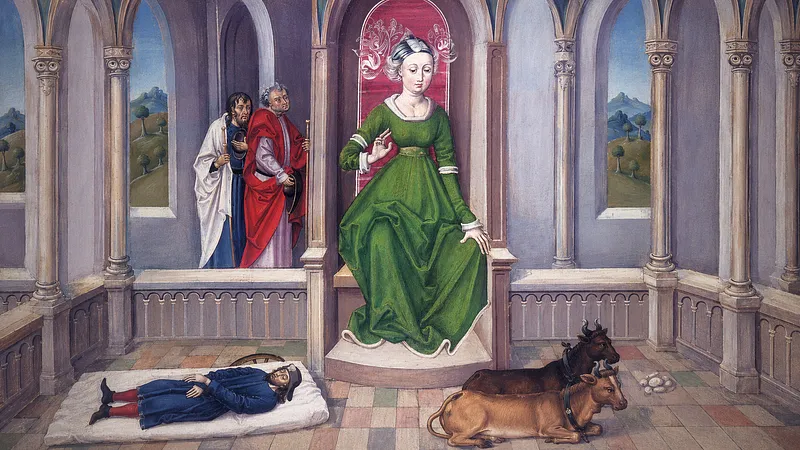 The body of the apostle Saint James and his disciples Theodore and Athanasius before Queen Lupa, 1480 — Xacopedia
Arriving in Galicia, the disciples faced a practical problem: where to bury their master? The land was ruled by a pagan queen named Lupa, a name that means she-wolf in Latin.
Before they even went looking for her, the first wonder happened. They laid the body on a huge stone, and the stone softened like wax, molding itself to the body until it became a perfect sarcophagus. The land recognized the saint before its inhabitants did. Even so, they needed permission, and that is where the legend gained three trials of increasing difficulty.
In the first trial, Lupa pretended she had no power to decide and sent the disciples to consult Regulus, high priest of the Ara Solis, the altar of the sun that stood in Duyo, on the headland where Fisterra is today. His name is not decorative: Regulus is the brightest star in the constellation Leo.
Regulus hated Christians and had the two arrested. During the night, small lights appeared inside the cell and traced on the wall the outline of a door that did not exist. The disciples went through the wall there and escaped into the darkness. Regulus sent soldiers after the disciples, and the bridge over the river collapsed while his pursuers were crossing it.
While the two were in Duyo, the queen took the chance to send her soldiers to fetch the body. That is when the strangest scene in the whole legend happened. The apostle’s body rose into the air by itself and began moving east. The soldiers followed it, without the courage to touch it, and watched as it went around the mountainous region of La Oca, the Goose, and came down on Pico Sacro. Some stayed on guard and built a tomb there. The others went back to tell the queen.
In the second trial, Queen Lupa set a trap disguised as a favor and told them to fetch her oxen, loose on a hillside, to pull the cart with the body. Only on that hillside there were no tame oxen: there were wild, untamable bulls, and the queen knew it.
On the hillside, a dragon also charged at the disciples, spewing fire, with a breath that rotted the entire region. They made the sign of the cross and the beast burst open at the belly, vanishing in smoke. No sword was drawn: so far, nothing in this story has been defeated by force. Facing the bulls, they repeated the sign of the cross and the beasts became tame on the spot. They hitched the animals to the cart carrying the stone that had become a sarcophagus and let them go on their own.
The third trial brought the outcome. The oxen, with no one driving them, chose the way by themselves and ended up in the courtyard of Lupa’s own palace. It was too much for the queen. So Lupa converted, was baptized, offered her palace to become a church and ordered the temple of the Ara Solis destroyed.
But the disciples turned down the palace. They said the apostle’s final resting place should be chosen by the will of God. They climbed back onto the cart and let the bulls go on. The animals walked until they stopped beside a spring, in a field that also belonged to the queen, and she gladly donated the land.
The field came to be called Libere donum, free of owner. That is where the name Libredón would come from, the woods where, centuries later, the tomb would be found again. Before that, the place was known as Arcis Marmoricis, probably because it held Celtic and Roman burials, and popular devotion ended up reading in that name the apostle’s marble ark.
With the donation of the land, the three trials came to an end and the burial place was settled. A stone that molds itself. A dragon that spits fire. Bulls that grow tame. Oxen that choose the way. And a queen called she-wolf who hands over her palace to become a church. It is the image of a new religion settling on top of an old one, making use of what it found instead of razing it.
The star that found the tomb again
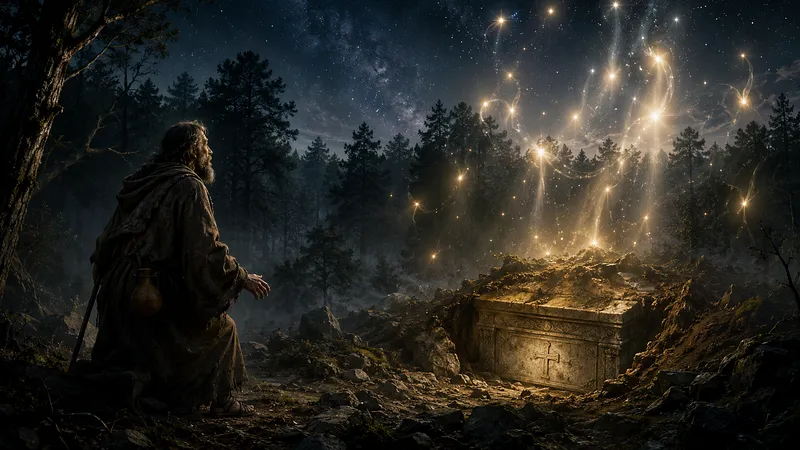 Pelagius discovering the tomb of the apostle James in the Libredón woods
After all this, the burial place was forgotten. Centuries of invasions and forgetting covered the site with vegetation, and no one knew anymore where it was. Until, sometime between 813 and 830, depending on the source, during the reign of Alfonso II of Asturias, a hermit named Pelagius noticed strange lights falling like a shower of stars over the field near his retreat. He lived next to the church of San Fiz de Solovio, built on the ruins of a Celtic sanctuary. The people living nearby saw the same lights.
The bishop of Iria Flavia, Theodemir, went to check. On witnessing the wonder, he decreed three days of fasting, went in procession to the Campus Stellae and had the ground excavated. They found a small marble mausoleum, with a tomb inside and, in the tomb, a body. It was identified as the apostle’s.
Theodemir reported the find to Alfonso II, who in turn notified Pope Leo III and the emperor Charlemagne. The king made a pilgrimage to the tomb, founded three churches there, and next to them a community of Benedictine monks settled in charge of guarding the tomb, the monastery of Antealtares. In 829 came the first royal donation. Compostela was born.
This is where the legend finds its most beautiful image. The tomb is not found by digging or by a document: it is pointed out by lights in the sky. And the name of the hermit who sees them, Pelagius, means man of the sea. Look at the whole chain. A boat guided by an angel crosses the ocean and reaches the end of the world. Centuries later, a man of the sea sees a star and finds the body again. Sky and sea carry the story from beginning to end.
The last act: the knight who returns
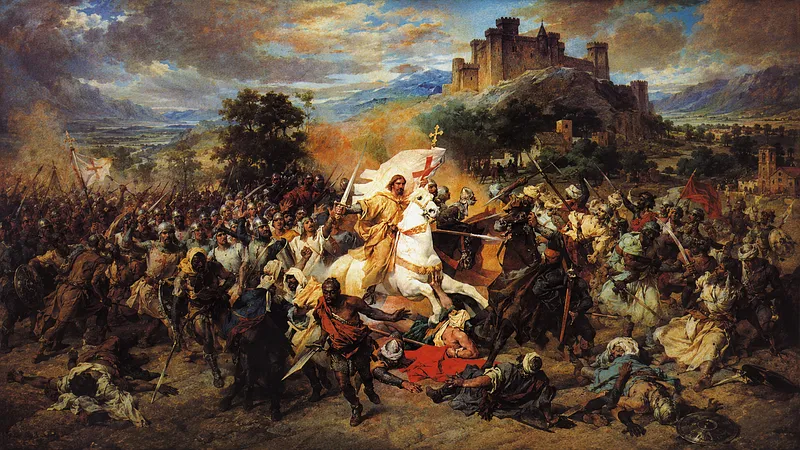 Saint James at the Battle of Clavijo — José Casado del Alisal, 1885.
The legend still had a surprise in store. The dead apostle would appear again, now alive and armed.
At the Battle of Clavijo, in 844, with the Christians in trouble against the Muslim troops, James is said to have appeared in the middle of the fighting, riding a white horse, wielding a sword of fire and leading his people to victory. From this feat came Santiago Matamoros, the Moor-slayer, the warrior apostle who became the patron saint of Spain.
It is worth stopping for a moment to look at the full design the legend traces. The apostle preaches and fails. He dies beheaded. His body crosses the sea toward the sunset. He is buried, forgotten, found again beneath a star. And finally he is reborn as a luminous knight. Death and resurrection, repeated in several registers, from beginning to end. This design is the key to understanding why so many people see the Camino de Santiago as a rite of rebirth and not just a journey. The legend rehearses the same movement several times before proposing it to whoever walks.
How the legend developed
One thing that helps a lot in understanding this legend is realizing that it was not born complete. It grew in layers, some three centuries later.
The oldest accounts of the translation of the body, which circulated around the year 1000, already featured Queen Lupa, the bulls and the persecution by the local priest, but did not name the disciples who traveled in the boat. In a 9th-century version there was even a different cast: the body was carried through the seven corners of Andalusia by seven apostolic men, who handed out images of the Black Virgin to the shrines along the way.
These seven were set aside in the early 12th century and replaced by two, Athanasius and Theodore, when the Church of Compostela produced its official version and included it in the Codex Calixtinus, also specifying that the burial had taken place in the Libredón woods, which by then was already called Compostela.
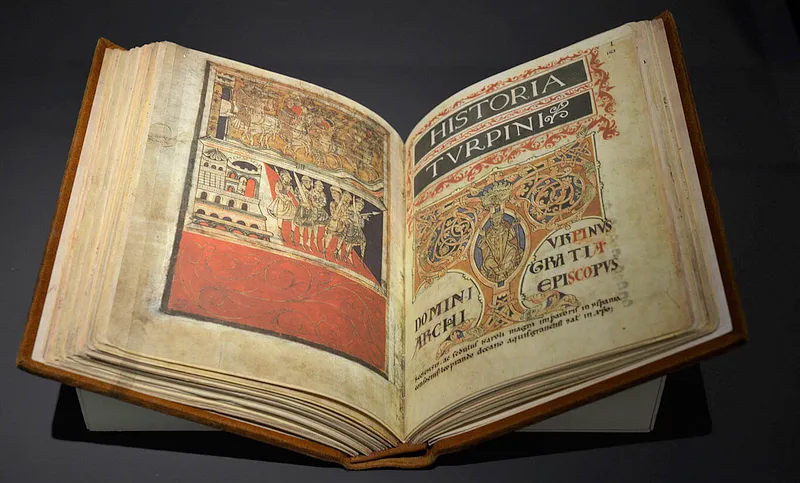 The Codex Calixtinus
The Codex Calixtinus is the great book of this tradition, kept in the cathedral of Compostela. Its five books bring together sermons, accounts of miracles, liturgical texts and narratives associated with Saint James. The fifth, traditionally attributed to Aymeric Picaud, is one of the first known medieval pilgrimage guides, with practical information on routes, lodging and the customs of each region.
A century later, the Dominican Jacobus de Voragine included the life of Saint James in his collection of saints’ lives, the Legenda Aurea, or Golden Legend, which was read all over medieval Europe and shaped much of the way saints came to be depicted in art. That work gave the tradition the name it became known by. In Portugal, it circulated in the monasteries and hostels from the 13th to the 17th century, told aloud to the pilgrims passing through.
From the historians’ point of view, there is no early testimony that James actually preached in Spain. Saint Julian of Toledo, in the year 686, wrote that the apostle had preached among the Jews, and the bishop of Iria Flavia completely ignores the episode of the boat. There is the tomb, there is the decision to identify it as apostolic, and there are the political reasons of an Asturian kingdom that needed a patron saint to face Islam and secure its position among its neighbors.
The other possible body
There is even a hypothesis that usually disappears from devotional versions of the legend, and it is the most unsettling of all.
Priscillian was born around 340 in Gallaecia, into a senatorial family, and became bishop of Ávila. He led an ascetic Christian movement that criticized the wealth and authority of part of the episcopate, valued poverty, the study of Scripture and a level of female participation unusual for the time.
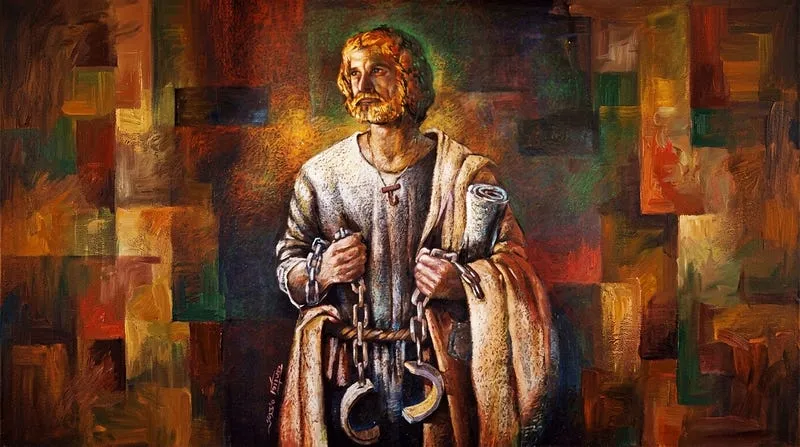 Bishop Priscillian of Ávila
The reaction was swift. Priscillian was accused of sorcery, condemned in a trial set up for the purpose and executed in Trier in the year 385. He became the first Christian sentenced to death by a secular court as a result of a heresy dispute among Christians. The property of the families involved went to the State. The Church’s assets remained untouched.
The movement did not die with him. It survived on the Peninsula until the middle of the 6th century. At the Council of Toledo in the year 400, eleven of the twelve Galician bishops present were Priscillianists.
In 1900, the hagiographer Louis Duchesne published an article with an uncomfortable suggestion: the body buried in Compostela would be Priscillian’s, not the apostle’s. The hypothesis rests on a 5th-century account by Sulpicius Severus, according to which the disciples took their master’s remains back to his homeland. After him, the Spanish historian Claudio Sánchez-Albornoz, the writer Fernando Sánchez Dragó and the philosopher and essayist Miguel de Unamuno helped popularize the idea.
There is a strong argument on the other side. Neither in the 4th century nor in the 9th did Compostela have the importance of Iria Flavia or Braga, which were also Priscillianist centers. If the goal was to hide a Galician martyr, that was not the obvious place.
None of this diminishes the legend. It only helps us understand what it is: a symbolic construction assembled piece by piece, over generations, with a care that makes it even more interesting. The French writer and journalist Louis Charpentier, author of Les Jacques et le mystère de Compostelle, a work devoted to the initiatory interpretation of the Camino, suggests that this tradition was not forged all at once. For him, the narrative adjusted itself, over time, to older elements associated with the place, the path of stars, the shell, the name, Queen Lupa and the dog.
You don’t have to pick a side to notice what the hypothesis brings to light. On that ground, before any basilica, there was a different Galician Christianity, popular, persecuted and stubborn, which survived for two hundred years after the execution of its leader. The central question of this hypothesis is not whose body it is, but why Compostela became, not long after the supposed burial, one of the greatest pilgrimage centers in Europe.
The symbols of the legend and their pagan roots
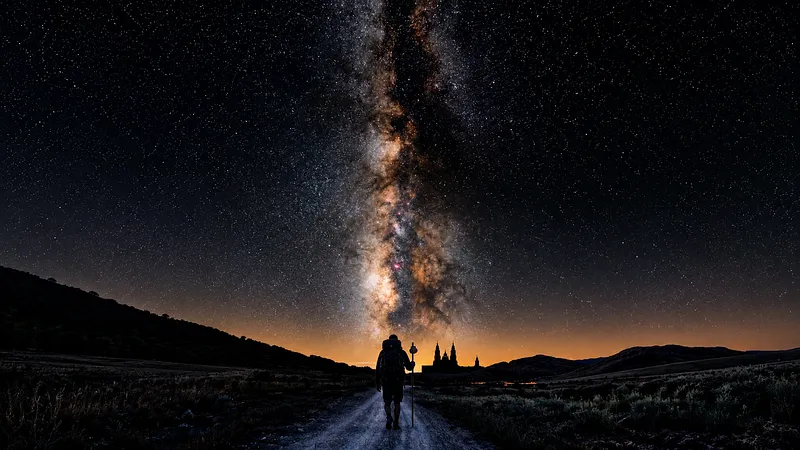 The Milky Way and the path of stars to Santiago de Compostela
The road of stars
In the Middle Ages, the popular name for the Milky Way in much of Europe was the Camino de Santiago, the Way of Saint James. The whitish band that crosses the night sky from east to west served as a reference for travelers, and the belief was that it pointed to Compostela.
Charpentier drew attention to a detail that usually goes unnoticed. At the end of the Milky Way lies the constellation of Canis Major, with Sirius, the brightest star in the sky. And the legend gives Saint James precisely a dog as his companion. The earthly road mirrors the celestial road, and the dog that goes with the apostle is the same one that shines at the end of the path of stars.
It is worth adding a link that is usually missing from this reading. In traditional symbolism, the dog is the domesticated version of the wolf. It is the one that accompanies and guides those who seek initiation, and the legend has this animal lead the apostle to a land ruled by a she-wolf. In medieval iconography, the dog’s head was lent to the initiated craftsmen, the cynocephali, the same ones who built the buildings along the Jacobean routes. On the south façade of the cathedral of Compostela, built between 1103 and 1111, Saint James appears with his foot on a dog’s head.
For the Celtic peoples, that band of light had another name and another function: it was the path of souls, the route the dead traveled toward the other world. Add to this the westward direction the boat of Saint James traveled and the picture becomes clear. Walking to Compostela is following the trail of souls toward the sunset, exactly as the peoples who were there before used to do.
Why a she-wolf receives the apostle
The pagan queen’s name is no accident. Lupa, the she-wolf, rules over the region of Lugo. And Lugo carries in its name the Celtic god Lug.
Lug, or Lugh, was one of the supreme deities of the Celtic pantheon. God of light, master of all arts and crafts, warrior and magician at the same time, the one who knows how to do everything.
In Charpentier’s etymological interpretation, the closeness in sound between Lug, the Old French lou and the Latin lupus would allow us to read the she-wolf of the Christian tradition as a transposition of the Celtic god. The Celtic god of light and the she-wolf of the Christian legend share the same root of sound.
The Portuguese historian and writer Vítor Manuel Adrião, author of Codex Jacobeu: de Portugal a Santiago de Compostela and devoted to the study of Portuguese medieval symbolism and tradition, proposes an interpretation that does not depend on this etymological association. For Adrião, Lupa would also point to Lupe and to the Moon, the heavenly body that marks the cycles, governs the tides and shines with a light that is not its own.
And look at whom the legend makes her answer to: to decide about the apostle’s body, the lunar queen has to consult Regulus, the priest of the altar of the sun. The Moon depends on the Sun in the legend exactly as it does in the sky.
After this, it is hard to see the date of the feast of Saint James as a coincidence. The feast falls on July 25, a period associated, in tropical astrology, with the Sun’s entry into the sign of Leo. Regulus, in turn, is a star traditionally linked to that zodiac figure.
Adrião also identifies traces of Lug in place names on the Peninsula formed from the roots Lug and Lux, the latter related to light. Lusitania itself would be the Land of Light, and Lisbon, Logroño and Lugo would belong to this same luminous lineage. It is worth noting that Logroño and Lugo sit right on the Camino.
What the Church did, in this reading, was absorb the old solar god and distribute him among Christian figures. Lug reappears in Saint Michael, the archangel of light who faces the dragon, and also in Saint Lawrence, the martyr burned on the gridiron whose feast falls in August, precisely when the sky produces the meteor shower people call the tears of Saint Lawrence.
Look again, now, at the dragon defeated by the disciples and at the tamed bulls. They are no longer decorative episodes. They are the image of the new religion absorbing the forces of the land, taming what was wild and putting it at the service of the Christian sacred. And the she-wolf queen, who surrenders last, is the pagan land itself accepting its new owner.
Lusina, the goddess hidden in the female saints
If Lug is the masculine, solar principle of this story, he has a feminine counterpart that the legend guards carefully. Adrião calls her Lusina, or Melusina, and identifies her with Ataecina, the ancient Celtic-Lusitanian goddess linked to regeneration, the earth and spring. She would be the Mother Goddess of the pre-Christian peoples, the one for whom menhirs and dolmens were raised, worshipped at springs, in caves and at great stones.
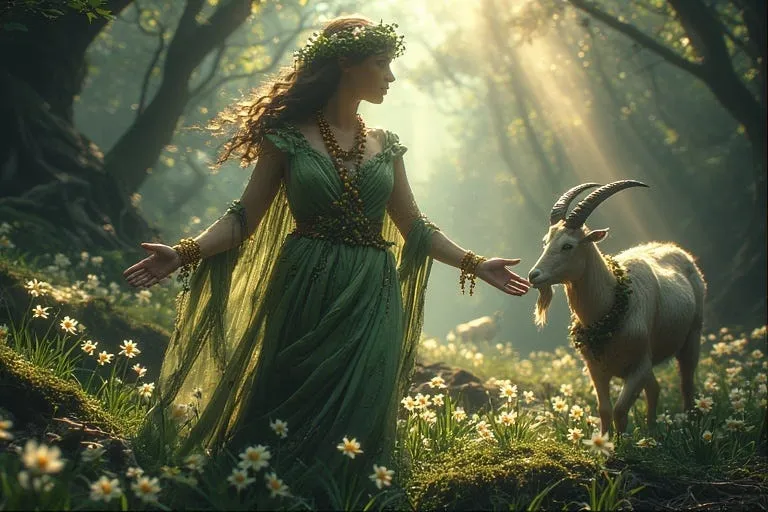 Illustration of the Celtic goddess Ataecina, or Lusina.
This goddess did not disappear when Christianity arrived. She was absorbed into several Christian female figures, and the trail is recognizable. She took on the face of Saint Lucy, whose name holds light and whose protection falls on the eyes, the organ of sight. She took on the face of Mary Magdalene, whom the Provençal tradition has withdraw into a cave in the south of France, an exact image of the womb of Mother Earth. And above all she took on the face of the Black Virgins, so venerated along the pilgrimage routes and almost always found in caves or over springs welling up from the ground.
Remember the images James carried in his saddlebags and kept leaving along the way? These are the ones. In one of the old versions of the legend, they are Black Virgins carved by Saint Luke himself, distributed among the main shrines of the route. The Christian legend explains, through an evangelist, the presence of a dark female figure in every cave and every spring along the way.
And there is one last piece that completes the design. Saint Luke is credited with the roles of painter, sculptor, writer and musician, the same attributes the Celts gave to Lug, father of all the arts, who according to the myths passed on part of his knowledge through his wife, the goddess Lusina. In the Christian version, Luke and Mary occupy exactly the positions of Lug and Lusina.
Notice the pair that runs, veiled, through the whole legend. A masculine principle, solar, celestial, tied to the stars and to light. And a feminine principle, telluric, tied to the earth, the waters and the stones. Saint James and the Virgin, in the Christian version. Lug and Lusina, in the pagan reading. It is this marriage between heaven and earth that gives the Camino its power as a rite of passage, and that is why the legend’s two Marian apparitions happen precisely on stones.
The goose and the Game of the Goose
Here we come to the most intriguing symbol of all. Along the Camino de Santiago, one animal shows up with an insistence that does not seem accidental: the goose, or oca, as it is called in Spanish.
It is in the place names, from the beginning of the route to its end. There is the Ansó valley, near Jaca, where the crossing of the Pyrenees begins. There are the Montes de Oca, already in Castile. There is the village of El Ganso, in the mountains of León. There is a Paso de la Oca near Compostela. Scattered over hundreds of kilometers, always within the same corridor, these names trace a trail.
And the trail is not only on the map. It is inside the legend itself, in its strangest episode. When Lupa’s soldiers go to seize the apostle’s body, it rises into the air and moves by itself, and what the soldiers see is the body going around the mountainous region of La Oca, the Goose, before coming down on Pico Sacro. The goose is not a toponymic curiosity stuck on from the outside. It is in the flight plan of the most important corpse in the history of the Camino.
Why a goose? In ancient mythologies it is a border animal, a messenger between heaven and earth, a guide to the other world. Among the Celts it was forbidden food, a sign that it held sacred status. And there is a visual detail that completes the reasoning: the goose’s foot, stylized and pointing downward, comes down to three lines opening out from a single point. This sign, the goose foot, was a teaching mark of the druids.
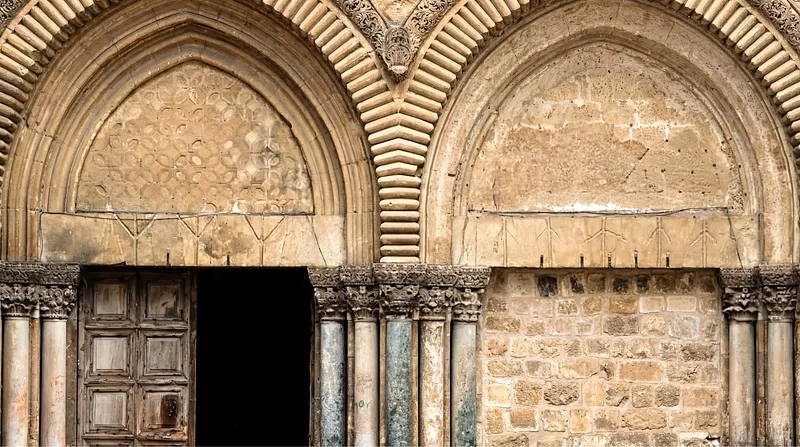 The double entrance of the Church of the Holy Sepulchre in Jerusalem, with its 8 carved goose feet.
Adrião offers a valuable observation here. On the funerary steles of the old cemetery of Iria Flavia, the landing point of the apostle’s boat, the free builders signed their work with a goose foot, a simplified form of the fleur-de-lis. For him, this sign was the emblem of Lusina, the patron goddess of these builders. The pagan symbol survived carved in stone, beside the tombs, in plain sight of anyone who knew how to read it.
And then there is the game. There is an old European board game called the Game of the Goose, or Game of Glory, in which the player advances along a spiral of numbered squares toward the center, helped by the squares with geese and held back by traps: a bridge, a well, a labyrinth, and a dreaded square called Death.
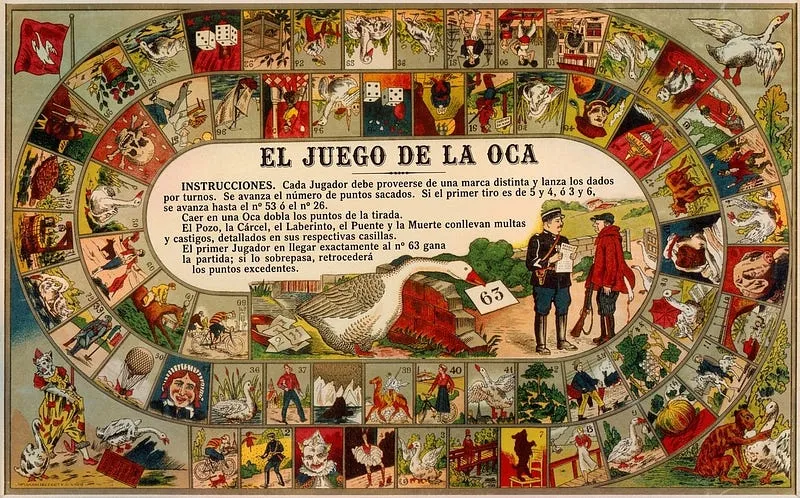 The Game of the Goose
Many scholars of initiatory traditions see this game as an allegory of the Camino itself. Adrião observes that the board has 63 squares; the sum of its digits, six plus three, gives nine, a number Adrião associates with the cycles of the Earth. The pilgrim would advance from goose to goose, going through symbolic deaths, until being reborn at the end.
No one knows whether the game was born from the Camino or the Camino inspired the game, and it should be said that the most widespread version today, that of a coded map created by the Templars, is a modern invention with no documentary basis. Even without documentary proof of that origin, the proposed correspondences between the board and the symbolic points of the route make the comparison suggestive.
Finally, there is a recent coincidence worth noting, and it is right in front of everyone who walks the Camino today. The yellow arrows that guide the Camino were created in the 1980s by Elías Valiña Sampedro, the parish priest of O Cebreiro, who devoted his life to studying and reviving the route. He went out marking the way from Roncesvalles to Compostela with yellow paint.
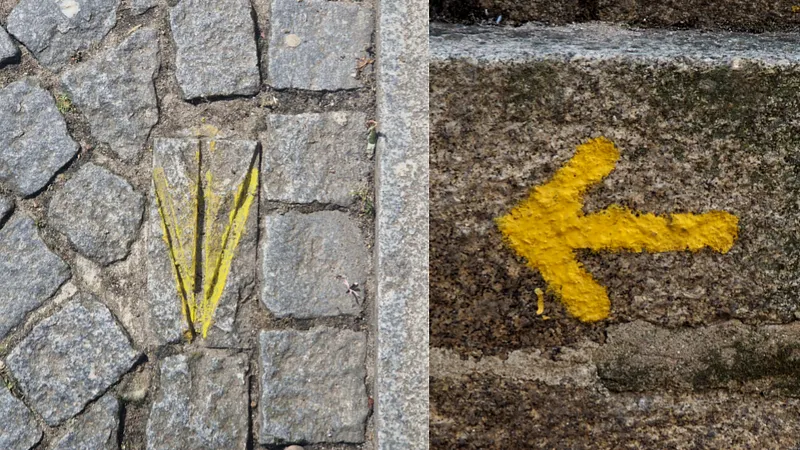 Yellow arrows marking the Camino de Santiago
Now look at the shape of the arrow. Two lines converging on a vertex, plus the central stroke coming out of that same point. Three lines and a vertex, exactly what the druids used as a teaching mark and what the medieval builders left carved on the stones they laid.
The priest was not recovering any ancient sign, he was solving a practical signage problem with the paint he had on hand. And still he chose, perhaps by chance, the same figure the scallop shell already hid in its ridges and that the builders signed on the steles of Iria Flavia.
The shell
We come back to the symbol from the beginning, the one that appears on every marker along the road. The scallop shell.
The legend explains its origin with a miracle. When the boat was approaching the coast, the people of Gaia and Maia were celebrating a wedding on the beach. The knights were playing games with their lances, and one of them fell into the sea with his horse. He vanished under the water to everyone’s horror. When enough time had passed that there was nothing left to hope for, he resurfaced alive beside the boat. Both he and the horse were completely covered in scallop shells. The disciples blessed him and he walked back to the celebration.
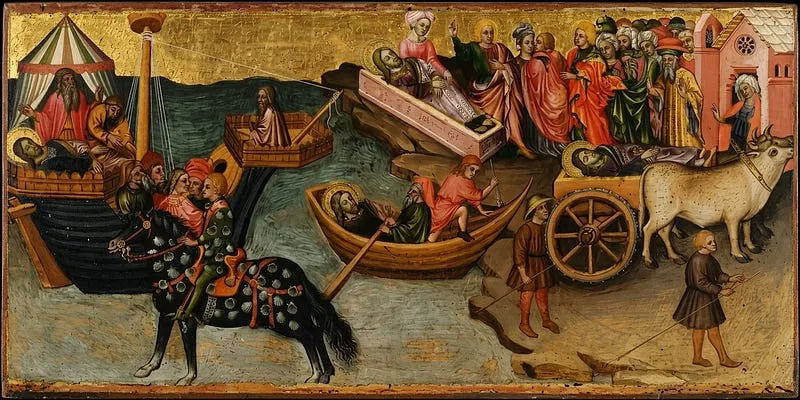 The knight covered in shells in the Translation of the body of Saint James — panel by Giovenale da Orvieto, 1441.
One way or another, the scallop shell became the badge of those who completed the pilgrimage, proof that they had reached the end of the world and come back to tell the tale.
Only the shell keeps a secret of form. Look closely at a scallop shell. The ridges that fan out, converging on a single point at the base, look a lot like a webbed foot. More precisely, they look like a goose foot. Several authors of the esoteric tradition argue that the shell of Saint James is the Christianization of that old builders’ sign. When it became risky to display the pagan symbol, it was turned into a shell, justified by a beautiful legend, without losing the essential design of the lines that open out.
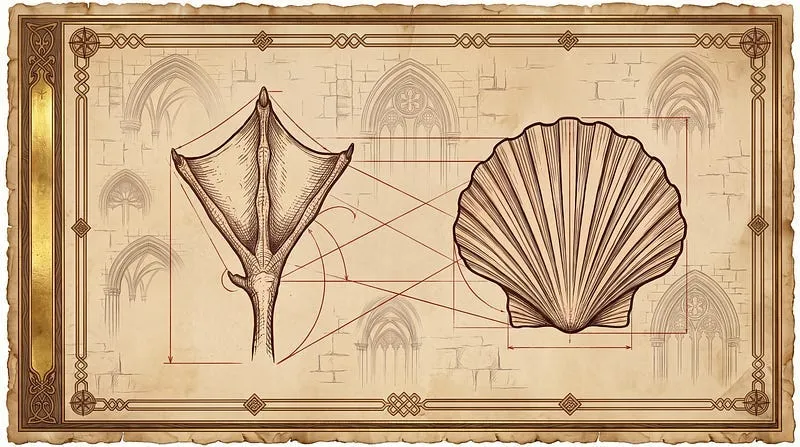 Goose foot vs. scallop shell
The symbolism of the scallop shell is generous and holds several readings at once. The converging ridges represent the many roads that set out from all over Europe and meet at a single destination. In the ancient world the shell was also an emblem of fertility and of the feminine, associated with Venus, the goddess born from the sea on a shell. The connection is even in the word: veneris is at the root of venerabilis, venerable.
René Guénon, the French author, noticed another clue. In some regions of France the scallop shell is called creusille, a word close to creuset, the crucible, the vessel in which the alchemist melts down matter. The pilgrim’s shell carries in its name the idea of purification by fire, which the Pythagoreans called catharsis and treated as the preparatory phase of initiation.
And there was a time when it was not just an emblem. Before wooden rattles, the Luso-Galician peoples of the coast clapped two scallop shells against each other, like primitive castanets that Galician and Ribatejo folklore still uses. That sound accompanied the litanies dedicated to the goddess of the night, represented by Venus, the planet of shepherds, sailors and pilgrims. Later the same image was absorbed into the Marian litany as Stella Maris, star of the sea.
Even the most ordinary object in the backpack carries, hidden, the echo of that Mother Goddess of the waters. And it was once a musical instrument in her rites.
A detail Charpentier records with humor: these shells were called merelles, a name that comes from a village on the Galician coast, and scallops do not stick to bodies or hulls, since they live loose on the seabed. The miracle was built to give thousands of pilgrims a recognizable badge. Its logic is symbolic, and that is exactly why it works so well.
The staff, the gourd and the direction
That leaves the travel companions. The classic pilgrim carries a staff, the tall stick that helps on the climbs and keeps dogs and dangers away, and a gourd hanging from it to carry water. They are practical objects that identified the pilgrim, but they also have a symbolic dimension.
The staff is the stick of the spiritual traveler, the same one that appears in Moses’ rod and in the staff of the old magicians of ancient tales. A symbol of authority and support, it marks the one who is authorized to walk the sacred path.
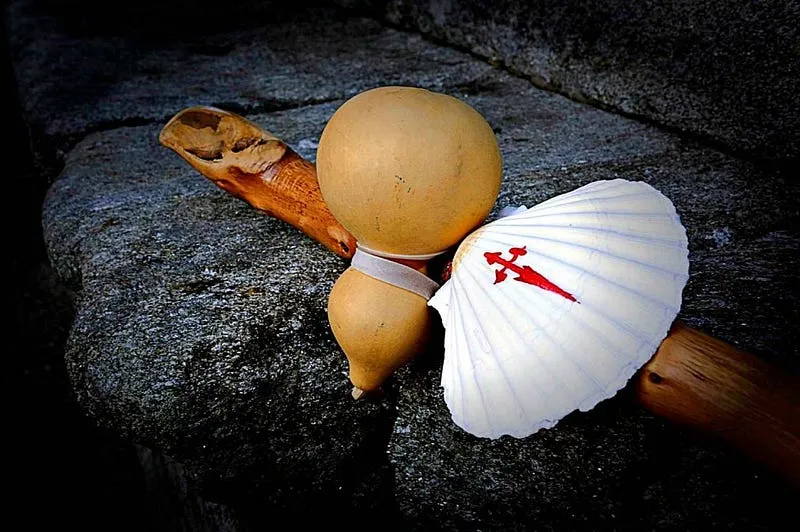
But the legend had already told us what it was for. When Hermogenes converted and was terrified of revenge from the demons he used to command, James gave him his own staff as protection. Within the story, the pilgrim’s staff is born as a shield against what was left behind. Everyone who leaves home carrying a staff is repeating that gesture, whether they know it or not.
The gourd points to divine provision and to purification, since water goes with the walker and washes him clean. It is easy to recognize in these objects traces of much older ritual instruments, given new meaning by Christian devotion.
The direction brings these symbols together. For the ancient peoples of Atlantic Europe, the west was the destination of souls, because that is where the sun dives into the sea every evening to be reborn the next morning. The Celts placed in that direction the island of Avalon, the blessed dwelling of the dead. For Charpentier, the continuous movement toward the west brings Compostela close to the old pilgrimages of death known in Brittany and Cornwall.
It is no accident that many pilgrims continue on to Finisterre, the end of the earth, and there burn a piece of clothing or their worn-out boots. It is a gesture of letting go, the old self left behind at the edge of the world. Adrião recalls that the ancient druidic initiation rites included exactly this drama, with the initiate declaring I have died and I have risen. The Camino kept the essence of the rite in Christian garb: you set out as one person and arrive as another.
Compostela, the field of the star
Finally, the name of the destination remains.
The most popular reading derives Compostela from Campus Stellae, the field of the star, in reference to the lights that pointed the tomb out to the hermit Pelagius. It is beautiful and fits the legend perfectly. Scholars, more skeptical, prefer to derive the name from the Latin compositum, in the sense of cemetery, since the tomb lay in a necropolis. That also makes sense, and it is probably the correct etymology.
Charpentier adds a third possibility, coming from alchemy. Compost would be the star that forms on the surface of the crucible in one of the first operations of the Great Work, a sign that the work is on the right track. Compostela would then be the star over the field, the sign of a successful transformation. He also suggests a more guarded reading, which would make Compostela the Master of the star.
This alchemical reading is not a modern invention, and it is worth seeing how far it goes. Well-known alchemists made the pilgrimage, among them Arnaldus de Villa Nova and Ramon Llull, who even has a plaque in the cathedral commemorating his visit. And they read the Golden Legend as a coded manual, assigning a function to each piece of the story.
The boat is the athanor, the furnace where matter is transformed. The dragon is the creative fire. The pedrón is the prime matter. Lupa is the Moon and silver, the lesser mysteries. Regulus is the Sun and gold, the greater mysteries. Pico Sacro is the center, perfection achieved. The shower of stars Pelagius sees is the compound lighting up inside the crucible. The cathedral is the laboratory, a word formed from labor and oratorium, which is where the Benedictine ora et labora comes from. And the tomb is the work completed.
Notice that even the final square enters the account. Obradoiro was read as obra de ouro, a work of gold, the point where the pilgrim arrives after passing through the Door of Pardon, the Platerías door and the Portico of Glory.
You don’t have to accept this interpretation as historical truth or choose a single etymology. The three readings can live together as symbolic layers of the same tradition. A name that means cemetery, star and mastery all at once describes well what happens to those who walk there.
A road older than the apostle
We have come to the point that ties everything together. How did a body carried by a drifting boat end up precisely at the end of an ancient route aligned with the Milky Way, marked by megalithic monuments, facing the sunset of the dead and dotted with goose place names?
The answer the esoteric current offers is a bold one: the Camino would have existed long before Saint James. It would have been a pre-Christian pilgrimage route, opened by builder peoples who knew how to read the energies of the earth and the positions of the sky, walked westward in search of rebirth. The legend of the apostle would have come later, Christianizing an earlier tradition, giving Christian names to the old gods and saints to the ancient feasts.
This route of the ancient builders is a subject in its own right, with its own geography and its own evidence. What matters here is the consequence: the golden legend of Saint James did not erase what came before. It kept it. It worked like a chest that preserved the symbols of an older world precisely by translating them into the language of the new religion.
Perhaps that is why the Camino is still crowded in an age that claims to have no mystery. Whoever sets out today doesn’t need to believe any of this, but ends up touching, without knowing it, a layer of meaning that spans millennia. The shell on the backpack, the yellow arrow that replaces the star, the weariness of the body, the arrival at the sea. All of this was already being done long before, under other names.
To carry in your backpack
The beauty of this legend does not depend on it being literally true. It remained within reach of the collective perception, allowing each person to take from it the part that interested them most. Whoever wanted a saint took a saint. Whoever wanted an initiatory map took a map. Neither of them left deceived, and neither of them took the whole story.
That is why it still works. What the legend offers is a language of symbols that gives meaning to the simple act of walking, and that language never required unanimity about what it means.
I keep thinking that maybe this is what the Camino still does to people. It gives meaning back to gestures that everyday life has emptied out. Walking becomes a crossing. Getting tired becomes a trial. Reaching the sea becomes rebirth. And an ordinary shell, hanging from a backpack, goes back to being what it always was: the mark of someone who went to the end of the world and came back different.
And if making a pilgrimage means going through a symbolic death to be reborn transformed, what path have you been putting off out of fear of not coming back the same?
Medieval and primary sources
BÍBLIA. Bíblia de Jerusalém. Nova ed. rev. e ampl. São Paulo: Paulus, 2002.
MORALEJO, Abelardo; TORRES, Casimiro; FEO, Julio (trads.). Liber Sancti Jacobi: Codex Calixtinus. Santiago de Compostela: Xunta de Galicia, 1992.
SULPÍCIO SEVERO. Sacred History. Livro II, caps. 46–51. In: SCHAFF, Philip; WACE, Henry (eds.). A Select Library of Nicene and Post-Nicene Fathers. Second Series, v. 11. Buffalo: Christian Literature Publishing, 1894.
VARAZZE, Jacopo de. Legenda áurea: vidas de santos. Tradução de Hilário Franco Júnior. São Paulo: Companhia das Letras, 2003.
Authors cited in the article
ADRIÃO, Vítor Manuel. Codex Jacobeu: de Portugal a Santiago de Compostela. Lisboa: Espiral, 2025.
CHARPENTIER, Louis. Les Jacques et le mystère de Compostelle. Paris: Robert Laffont, 1971.
DUCHESNE, Louis. Saint Jacques en Galice. Annales du Midi, v. 12, n. 46, p. 145–179, 1900.
GUÉNON, René. À propos des pèlerinages. Le Voile d’Isis, jun. 1930. Reimpresso em: GUÉNON, René. Études sur la franc-maçonnerie et le compagnonnage. Paris: Éditions Traditionnelles, 1964–1965. 2 v.
SÁNCHEZ-ALBORNOZ, Claudio. En los albores del culto jacobeo. Compostellanum, v. 16, 1971.
SÁNCHEZ DRAGÓ, Fernando. Gárgoris y Habidis: una historia mágica de España. Pamplona: Peralta, 1978. 4 v.
UNAMUNO, Miguel de. Andanzas y visiones españolas. Madrid: Renacimiento, 1922. Biblioteca Virtual Miguel de Cervantes.
Recommended reading
BURRUS, Virginia. The Making of a Heretic: Gender, Authority, and the Priscillianist Controversy. Berkeley: University of California Press, 1995. University of California Press.
CHADWICK, Henry. Priscillian of Avila: The Occult and the Charismatic in the Early Church. Oxford: Clarendon Press, 1976.
NAVAZA, Gonzalo. Etimoloxías xacobeas. In: BOULLÓN AGRELO, Ana I.; MÉNDEZ, Luz (eds.). Os camiños de Santiago de Europa a Galicia: lugares, nomes e patrimonio. A Coruña: Real Academia Galega, 2022. DOI: 10.32766/rag.404.02.
SEVILLE, Adrian. The Cultural Legacy of the Royal Game of the Goose: 400 Years of Printed Board Games. Amsterdam: Amsterdam University Press, 2019. JSTOR.
VARELA RODRÍGUEZ, Joel. El Privilegio de los Votos de Santiago: edición crítica y traducción. Sacris Erudiri, v. 63, n. 1, 2024. DOI: 10.1484/J.SE.5.150134.