The management style at Ateliê de Software (part 3)
In this article
After many conversations with clients, partners and friends specifically to understand the way we work, we are sharing Ateliê de Software’s management style publicly.
Our goal is to inspire other organizations that want to implement modern management approaches, based on transparency and autonomy, fostering a more flexible and collaborative work environment.
➔ This is the 3rd in a series of 4 articles. It explains our organizational structure and presents our current management practices.
The practices of the Ateliê de Software Way reflect a modern, people-centered approach to management. They show how the organization works day to day and how our values, principles and premises show up pragmatically through management structures, processes and tools.
Organizational structure
Ateliê de Software’s structure is made up of high-performing, autonomous, multidisciplinary teams, connected in a network and oriented toward creating value for the client. There is no traditional formal position; instead, there is recognition of emergent leadership, which shows up to face challenges and solve problems in an agile way.
Project Teams are formed and organized according to the characteristics and needs of each software development project, and each one is fully responsible for serving a specific client.
The Ateliê also has Support Teams that handle administrative and financial, sales, marketing and people management activities. These support teams ensure the efficiency of internal processes and provide the support project teams need to work smoothly. When necessary, the support teams can rely on external consultants and specialized professionals, such as lawyers and accountants, who bring specific knowledge to strengthen the operation.
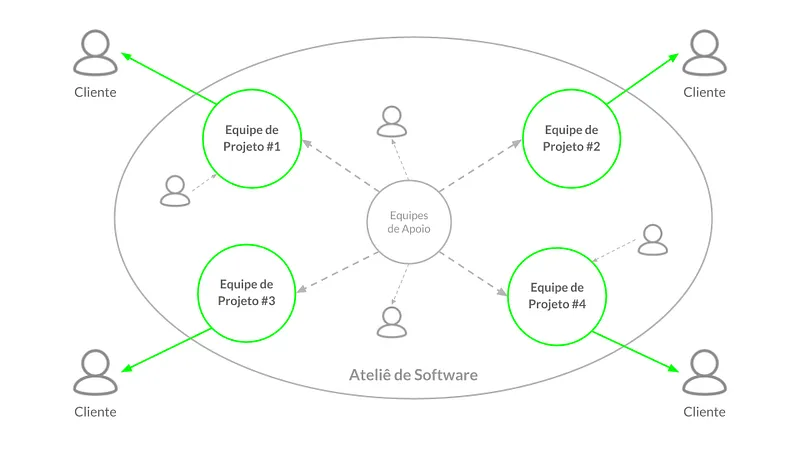
A simplified representation of Ateliê de Software’s organizational design
Project Teams, in turn, receive support both from the Support Teams and from more experienced professionals in software development, design and project facilitation. These specialists step in when needed, helping teams overcome specific challenges and fostering the development of innovative solutions.
To carry out certain initiatives or internal projects, Ateliê members also organize themselves into small Temporary Committees focused on specific goals, such as running immersion courses and events, organizing get-togethers, discussing salary raises, among others. These committees are formed as needed, with the autonomy to define strategies and implement solutions efficiently and collaboratively.
This structure promotes self-organization and individual and collective responsibility: roles are defined by the teams themselves, and professionals have complete freedom to adjust their functions according to their work needs and their skills.
Management practices
Ateliê de Software adopts management practices that favor self-management, collaboration and transparency, allowing each member to contribute to organizational development and to decision-making.
These practices reflect the Ateliê’s culture, built on trust and shared responsibility, creating a work environment that is flexible and adaptable to the needs of projects and clients.
Autonomous Teams
Looking at our organizational structure, it’s clear that autonomous teams are the heart of Ateliê de Software’s management style. These teams take full responsibility for their work, organizing their own schedules, locations, methods and tools, which reinforces an environment of trust and engagement.
Autonomy isn’t limited to carrying out the technical work. It extends to strategic decisions, such as hiring new members, defining plans, allocating resources and negotiating contracts.
Each team is multidisciplinary and made up of professionals with different skills who collaborate actively, taking on various roles tied to broader job definitions (so as not to limit what people can do).
There is no central figure of command; instead, leadership emerges according to the context and the needs of the moment. This approach distributes decision-making power among all members, removing bureaucratic barriers and fostering a culture of shared responsibility.
In addition, the independent teams are guided by the values of transparency and collaboration. All financial, operational and strategic information is widely shared, which makes informed and participatory decisions possible.
By eliminating the need for hierarchical supervision and strengthening self-organization, the Ateliê’s teams not only increase efficiency and innovation but also create a broader and more sustainable work environment, where each member is a protagonist in the collective success.
Professional Development and Feedback Culture
Professional development at Ateliê de Software is guided by a continuous feedback process and by creating opportunities for constant learning. The feedback culture isn’t aimed at comparing peers or at traditional performance reviews; on the contrary, it is used as a tool for individual growth.
To support this process, the Ateliê created the Feedback Canvas, an internal tool that organizes and structures feedback in the context of teamwork. The Feedback Canvas lets members align their perceptions and drive constant improvement, contributing to professional development and to team cohesion.
Finally, people have the autonomy to choose courses, events and training they consider relevant to their development. The teams themselves decide on investments in education, such as attending technology conferences, further expanding learning opportunities.
Decision-Making Processes
Decisions at Ateliê de Software are made in a decentralized way, favoring whoever is closest to the problems and has direct knowledge of the project or the context. We use two main decision-making methods:
- Consent-Based Decision: Decisions are made based on the best arguments, as long as there are no reasonable objections. This method encourages collaboration and the search for balanced solutions.
- Advice Process: For more complex issues, one member takes responsibility for making the decision but commits to consulting colleagues and specialists to ensure a broad, well-grounded perspective.
These methods are complemented by Working Agreements defined by the teams themselves, which set rules and constraints to ensure that individual decisions are aligned with the organization’s strategies, goals and values.
Decisions on Hiring, Firing and Salaries
Decisions about hiring, firing and discussing salary raises are made directly by the Project Teams, with support from the Support Teams for administrative and formal processes.
When necessary, the People Management Support Team helps with these conversations and facilitates feedback processes, making sure feedback is constructive and effective. This team also offers psychological support to members, providing a safe space to discuss emotional and professional challenges. This additional support contributes to people’s overall well-being and strengthens the culture of trust and mutual care at Ateliê de Software.
The salary system is aligned with the principles of transparency and autonomy, allowing professionals themselves to assign their obligations through a process of consent and consultation with their peers. To ensure that salary decisions are balanced and fair, the Ateliê uses a ranking of the value added by each member, comparing it to their total cost to the company. A specific committee is formed to analyze the ranking and adjust compensation when necessary.
Transparency and Profit Sharing
Transparency is an essential pillar of management at the Ateliê. Information about the company’s revenue, costs and expenses is accessible to everyone, enabling an honest and informed discussion about financial decisions.
In addition to salaries, the Ateliê distributes profits twice a year (at the end of each semester). The teams are responsible for defining the criteria and the formula for dividing the amount set aside for PLR (Participação nos Lucros e Resultados, Brazil’s profit and results sharing program), allowing the members themselves to decide how to distribute this share of the profit fairly.
Communication Routines
To foster organizational awareness and open communication, the Ateliê holds a series of regular meetings:
- Grande Roda do Ateliê (the Ateliê’s Big Circle): A one-hour weekly meeting where all teams update each other on their projects, challenges and activities, promoting transparency and integration.
- Support Team Meetings: Held weekly, these meetings allow the support teams (administrative and financial, sales and people management) to discuss and plan their activities and strategic decisions.
- Project Team Meetings: Project teams hold daily meetings to update one another on their activities, and run planning sessions and retrospectives as each project or client requires.
Remote Work and Physical Space
Since the pandemic, Ateliê de Software has made remote work the default, using Discord for day-to-day collaboration. We also keep a WhatsApp group for general and urgent communication, while Google Workspace organizes calendars, documents and processes.
Even so, the physical office in Poços de Caldas, Minas Gerais, is available to anyone who wants to work in person, providing a moment of camaraderie and social integration.
The management style at Ateliê de Software
- Part 1: Introduction and main influences
- Part 2: Values, proposals and principles
- Part 3: Organizational structure and management practices
- Part 4: Results and challenges
Originally published on Medium on November 5, 2024
Let's talk
Is your company rethinking its management model?
Let's talk about what makes sense for where you are now.